Body & healthIssue French supermarket fridges hacked to 50°C: what exactly happened?
Q. What temperature should a fridge be? And the freezer?
When hackers heated store fridges to 50°C (122°F) in the French supermarket fridge hack, about 700 supermarkets had to throw out their fresh and frozen food. It also raises a question closer to home. We open the fridge many times a day without knowing how cold it is inside, and many models only show a dial setting, not degrees. So what temperature should a fridge be, and how cold should the freezer be?
The short answer: keep the fridge at or below 4°C (40°F) and the freezer at -18°C (0°F), as the US Food and Drug Administration (FDA) advises. These numbers keep food out of the temperature range where bacteria multiply fastest. The UK’s Food Standards Agency (FSA) gives a range instead: set the fridge between 0 and 5°C (32-41°F).

What is the ideal fridge temperature in Celsius?
At or a little below 4°C (40°F). The FDA’s line is 40°F, which is 4°C. The FSA’s range is 0 to 5°C (32-41°F), and as an international note, South Korea’s food safety ministry (MFDS) also tells households to keep the fridge at 5°C (41°F) or below. The exact line differs slightly from country to country, but the goal is the same.
That goal is to stay out of the “danger zone”. The US Department of Agriculture (USDA) says bacteria grow most rapidly between 40 and 140°F (4-60°C), doubling in number in as little as 20 minutes. A fridge at 4°C (40°F) or below keeps food under that range. So a thermometer reading of 3°C (37°F) is fine, while 8°C (46°F) is too warm.
Here is the quick version:
| Temperature | Good to know | |
|---|---|---|
| Fridge | 4°C (40°F) or below | UK advice: 0-5°C (32-41°F) |
| Freezer | -18°C (0°F) or below | Pauses bacteria, does not kill them |
| Fridge door | Warmer than the shelves | Keep eggs on a shelf instead |
| Danger zone | 4-60°C (40-140°F) | Bacteria double in as little as 20 minutes |
What temperature should a freezer be?
The ideal freezer temperature is -18°C (0°F) or below. The FDA says 0°F, and the FSA says around -18°C. Fun fact: these are the same line. 0°F works out to -17.8°C, so countries that use Fahrenheit and countries that use Celsius landed on practically the same freezer setting.
Freezing does not make food sterile, though. The FSA points out that freezing does not kill bacteria, and they can revive as the food defrosts. So treat thawed food like fresh food. The safest way to thaw is in the fridge overnight. If that isn’t possible, the FSA suggests using the microwave’s defrost setting right before cooking.
How do you know your fridge is cold enough?
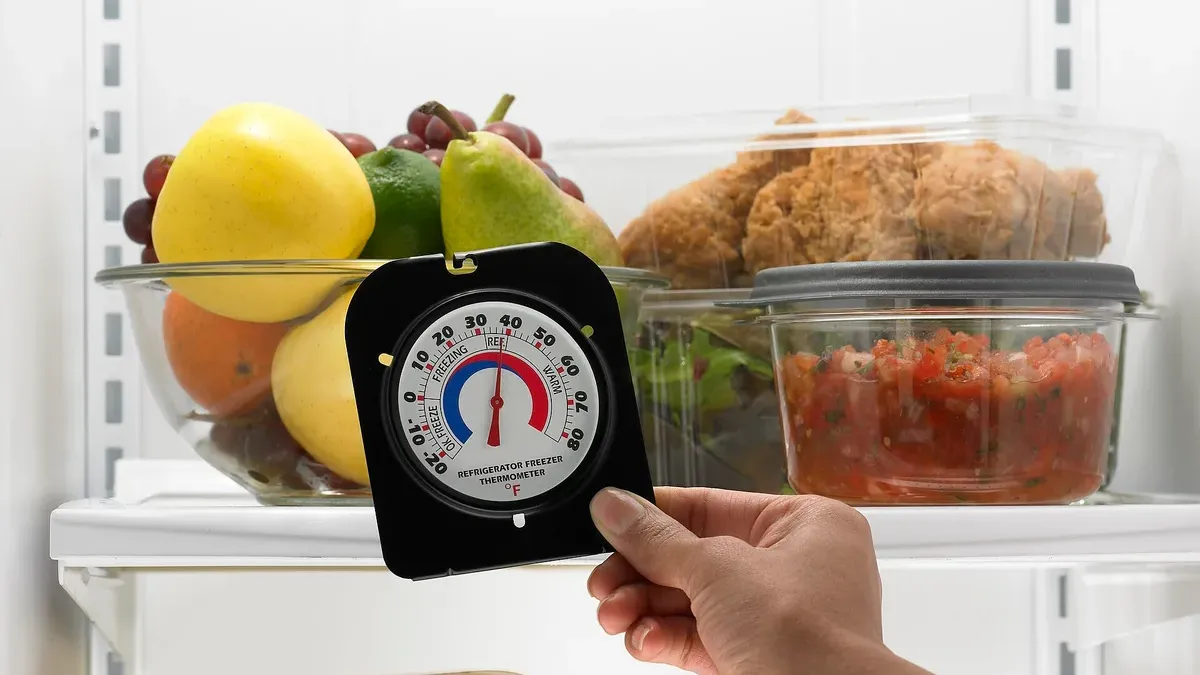
Check it with a thermometer. A dial setting is not a temperature, and the real temperature inside shifts with how full the fridge is and how often the door opens. The FDA calls appliance thermometers the best way to know, and they are generally inexpensive. Put one in the fridge and one in the freezer, near the front where they are easy to read, and check them at least once a week. The targets stay the same in winter and summer; the thermometer tells you whether your setting is reaching them.
A few habits help the fridge hold its temperature:
- Leave room for air. The FDA says not to pack the fridge or freezer so tightly that air can’t circulate.
- Keep eggs off the door. The door is warmer than the shelves, so the FDA says to store eggs in their carton inside the fridge itself.
- Cool hot food first, but not for long. The FSA says not to put hot food straight into the fridge, and to get cooked food in within one to two hours.
- Close the door. The FSA warns against leaving it open for long periods.
Why did the French supermarkets throw their food away?
Because 50°C (122°F) is well inside the danger zone. One chain said its fridges were kept at 50°C for six hours, and in that range bacteria can double in as little as 20 minutes. The freezers warmed up as well, so frozen food thawed too. With no way of telling what had grown, throwing it all away was the safe call.
How long is food safe in the fridge without power?
A power outage at home works the same way, only more slowly, because a closed fridge holds its cold for a while. According to the US Centers for Disease Control and Prevention (CDC), food stays safe for up to 4 hours in the fridge, 48 hours in a full freezer and 24 hours in a half-full one, as long as the doors stay shut.

After 4 hours without power or a cold source like ice, throw out perishable fridge food: meat, fish, cut fruit and vegetables, eggs, milk and leftovers. Thawed frozen food that still has ice crystals, or is at 4°C (40°F) or below, can be refrozen or cooked. It helps to write down when the power went off, and never taste food to check whether it is safe.
This article is general food safety information and does not replace professional advice or a medical diagnosis. If you have symptoms such as stomach pain or diarrhea after eating, contact a doctor.
In short
Keep the fridge at or below 4°C (40°F), or between 0 and 5°C (32-41°F) if you follow UK advice, and the freezer at -18°C (0°F); the targets stay the same all year. They keep food out of the 4-60°C (40-140°F) danger zone. If the power goes out, keep the doors shut, and throw out perishable fridge food after 4 hours without cold.
More from this issue
 French supermarket fridges hacked to 50°C: what exactly happened?
 Celsius vs Fahrenheit: what is 50 degrees Celsius in Fahrenheit?
 What is firmware, and what happens if you don't update it?
 What is the cold chain, and why throw away food after a power outage?
 Can smart home devices be hacked, and how do you secure them?
 Can AI hack? How far have AI cyberattacks really come?
People also ask
Is 3°C (37°F) a good fridge temperature?
Yes. It is below the US FDA's limit of 4°C (40°F) and inside the UK Food Standards Agency's range of 0 to 5°C (32-41°F). The number on the dial can differ from the real temperature, so check it with a fridge thermometer about once a week.
How long is food safe in the fridge without power?
According to the CDC, a closed fridge keeps food safe for up to 4 hours, a full freezer for 48 hours and a half-full freezer for 24 hours. After 4 hours without power or a cold source like ice, throw out perishable fridge food such as meat, fish, eggs, milk and leftovers.
Does freezing kill bacteria?
No. Freezing at -18°C (0°F) stops bacteria from growing, but the UK Food Standards Agency notes that they are not killed and can revive as the food defrosts. Thaw food in the fridge, or in the microwave just before cooking.
Sources
- US FDA - Are You Storing Food Safely?
- USDA Food Safety and Inspection Service - Danger Zone (40°F - 140°F)
- CDC - Keep Food Safe After a Disaster or Emergency
- UK Food Standards Agency (GOV.UK) - How to chill, freeze and defrost food safely
- Food Safety Korea (MFDS) - Managing your home fridge smartly (Korean)