Science & techIssue French supermarket fridges hacked to 50°C: what exactly happened?
Q. Celsius vs Fahrenheit: what is 50 degrees Celsius in Fahrenheit?
The French supermarket fridge hack came with a number that made readers stop: hackers pushed store fridges up to 50 degrees. If you grew up with American weather apps, 50 degrees sounds like light-jacket weather, not a disaster. So which is it? Is the 50 in the news Celsius or Fahrenheit, and what exactly is the difference between the two?
The short answer: the 50 degrees in the French reports is 50°C, which is 122°F. France, like most of the world, uses Celsius in daily life. The two scales read the same heat with different numbers, and one formula, °F = °C × 1.8 + 32, converts between them.

What is the difference between Celsius and Fahrenheit?
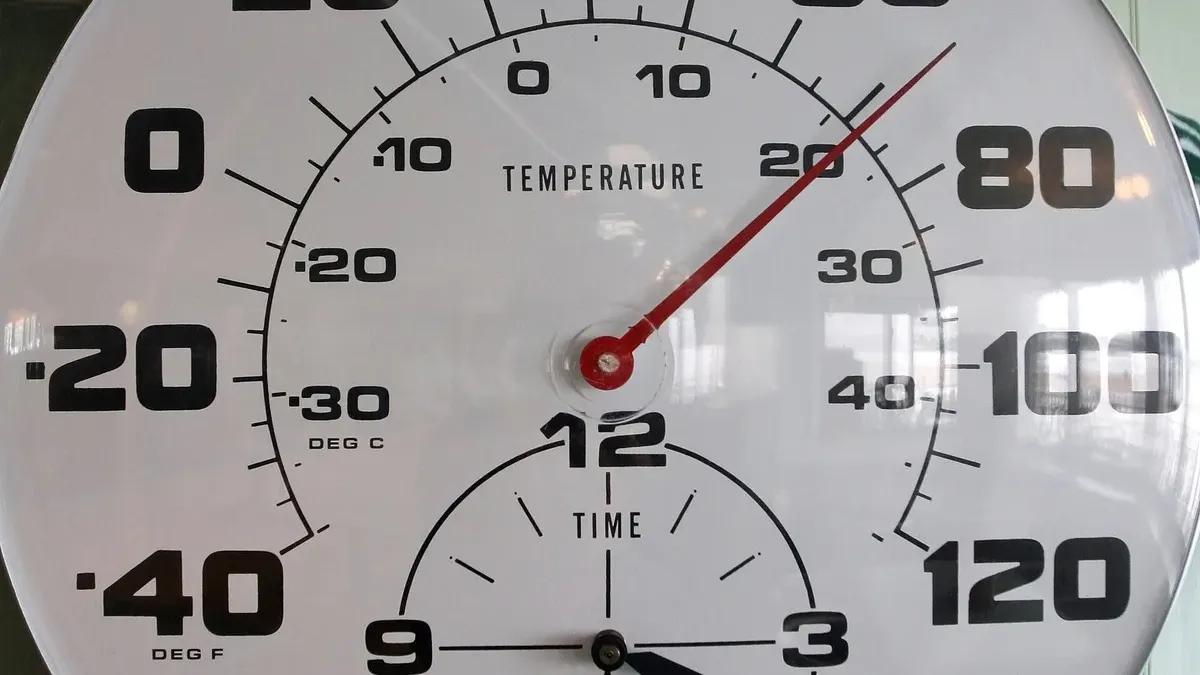
Both are scales for measuring temperature. They differ in only two ways: where they put zero, and how big one degree is.
Celsius sets the freezing point of water at 0° and the boiling point at 100°, with 100 steps in between. Fahrenheit puts the same two points at 32° and 212°, with 180 steps in between. Because the same gap is cut into 180 pieces instead of 100, a rise of 1°C equals a rise of 1.8°F. The boiling point shifts with air pressure, so it is usually given at sea level.
That is why the same number can mean very different things. If the French fridges had reached 50°F, that would be 10°C: too warm for a fridge, but nowhere near 50°C. Because the number was Celsius, stores threw out their fresh and frozen food to be safe. Weather reports in France, South Korea and most other countries use Celsius too, so a winter forecast of “minus 10 degrees” there means −10°C (14°F).
How do you convert Celsius to Fahrenheit?
There are only two formulas:
- Celsius to Fahrenheit: °F = °C × 9/5 + 32
- Fahrenheit to Celsius: °C = (°F − 32) × 5/9
9/5 is 1.8, the difference in degree size you just saw, and the 32 is there because Fahrenheit starts water’s freezing point at 32 instead of 0. To convert Celsius to Fahrenheit, multiply by 1.8 and add 32; to go back, subtract 32 and divide by 1.8.
Try it with the fridges: 50 × 1.8 = 90, and 90 + 32 = 122°F. Body temperature works the same way: 37°C × 1.8 = 66.6, plus 32 gives 98.6°F. Going the other way, 212°F minus 32 is 180, and 180 ÷ 1.8 is exactly 100°C, the boiling point of water.
Need a rough answer in your head? Double the Celsius number and add 30. That turns 20°C into about 70°F, close to the exact 68°F. The gap grows the further you move from mild weather, so use the real formula for cooking or a fever.

Here are temperatures you will see often. The fridge and freezer limits come from US Food and Drug Administration (FDA) food safety advice.
| Situation | Celsius (°C) | Fahrenheit (°F) |
|---|---|---|
| Where the two scales meet | −40 | −40 |
| Freezer (at or below) | about −18 | 0 |
| Water freezes | 0 | 32 |
| Fridge (at or below) | about 4 | 40 |
| Mild spring day | 20 | 68 |
| Body temperature | 37 | 98.6 |
| The hacked French fridges | 50 | 122 |
| Water boils (at sea level) | 100 | 212 |
Which temperature is the same in Celsius and Fahrenheit?
Look at the top row. Celsius and Fahrenheit agree at exactly one temperature: −40°. −40 × 1.8 = −72, and −72 + 32 brings you back to −40. Fahrenheit starts 32 degrees ahead at freezing but drops 1.8 degrees for every 1 degree Celsius, so the gap closes after 40 steps: −40°C is also −40°F.
Why is freezing 32°F, and was Celsius once upside down?
Fahrenheit came first. Daniel Gabriel Fahrenheit, a Polish-born Dutch physicist and instrument maker best known for the mercury thermometer, introduced his scale in 1724. According to Britannica, he set zero at the temperature of an ice-and-salt mixture and first chose 30° for freezing water and 90° for body temperature, later revised to 32° and 96°. A final adjustment put normal body temperature at 98.6°F (37°C). That is why water freezes at the odd-looking 32°F (0°C) instead of zero.
Celsius followed in 1742, proposed by the Swedish astronomer Anders Celsius, and his first version ran the other way: 0° was the boiling point of water and 100° the melting point of snow. The scale was later flipped so that 0° sits at the cold end and 100° at the hot end. Accounts differ on who flipped it first; the Swedish botanist Carl Linnaeus is one name that often comes up. The symbols °C and °F simply carry the two men’s initials.
Fun fact: Korean calls the scales seopssi and hwassi, literally “Mr. Seop” and “Mr. Hwa”, after the first syllables of old Chinese spellings of Celsius and Fahrenheit.
Why does the US still use Fahrenheit?
Fahrenheit spread first, so English-speaking countries such as Britain and the US used it for a long time. When many countries moved to the metric system in the 20th century, their everyday temperatures switched to Celsius too.
The US did try. Congress passed the Metric Conversion Act in 1975, but according to a history by NIST (National Institute of Standards and Technology), the US National Institute of Standards and Technology, the law set up voluntary conversion with no deadline. NIST says leaving adoption voluntary tends to slow progress, and it describes the US as one of a few countries that still use non-metric units in daily life. Replacing every weather forecast, cookbook and thermostat setting at once is another reason people often give.
That does not mean Americans never use Celsius. NIST notes that metric units have been legal in the US since 1866 and that health care measurements are mostly taken in metric. Science uses Celsius everywhere. Some people argue that Fahrenheit’s smaller degree, about 0.56°C, suits everyday weather talk better; others say that is simply habit.
In short
The 50 degrees in the French fridge story is 50°C, or 122°F. Celsius and Fahrenheit differ only in where zero sits and how big a degree is, so multiplying by 1.8 and adding 32 takes you from one to the other. The US still uses Fahrenheit largely because its switch to metric was left voluntary.
More from this issue
 French supermarket fridges hacked to 50°C: what exactly happened?
 What temperature should a fridge be? And the freezer?
 What is firmware, and what happens if you don't update it?
 What is the cold chain, and why throw away food after a power outage?
 Can smart home devices be hacked, and how do you secure them?
 Can AI hack? How far have AI cyberattacks really come?
People also ask
What is 100°F in Celsius?
About 37.8°C. Subtract 32 from 100 to get 68, then divide by 1.8 to get 37.77... That is a little above normal body temperature, 37°C (98.6°F).
Is there a quick way to convert Celsius to Fahrenheit in your head?
For a rough answer, double the Celsius number and add 30. 20°C comes out at about 70°F, close to the exact 68°F. The gap grows the further you move from mild temperatures, so use °F = °C × 1.8 + 32 for cooking or anything health-related.
Which countries use Fahrenheit?
The best-known country that uses Fahrenheit in everyday life is the United States. France, South Korea and most other countries use Celsius, and so do scientists everywhere.