Issues
Q. New dwarf planet candidate 2026 ED138: what did Rubin find beyond Pluto?
On 27 October, astronomers announced that the Vera C. Rubin Observatory in Chile had found a large, icy world beyond Pluto, and headlines soon called it a possible sixth dwarf planet. Its name is 2026 ED138, and every official statement attaches the same careful word to it: candidate. So what exactly did Rubin find?
The short answer: 2026 ED138 is the first dwarf planet candidate found by the Vera C. Rubin Observatory, an icy object beyond Neptune that is now about 46 au (astronomical units) from the Sun and an estimated 600 to 1,500 km across. It is probably big enough to be round, which is what a dwarf planet needs, but its size has to be pinned down before anyone can say for sure.

Who found 2026 ED138, and how?
Matthew Holman, an astrophysicist at the Harvard & Smithsonian Center for Astrophysics, spotted it on the evening of 13 October. He was running data from Rubin’s Simonyi Survey Telescope, collected earlier in 2026, through a search code he built with his colleague Kevin Napier. The code compares billions of detections of moving objects and links the ones that belong to the same body. This one’s brightness and distance pointed to an unusually large object. Holman calls his first reaction “excited disbelief”, and he began by checking whether he or the code had slipped up.
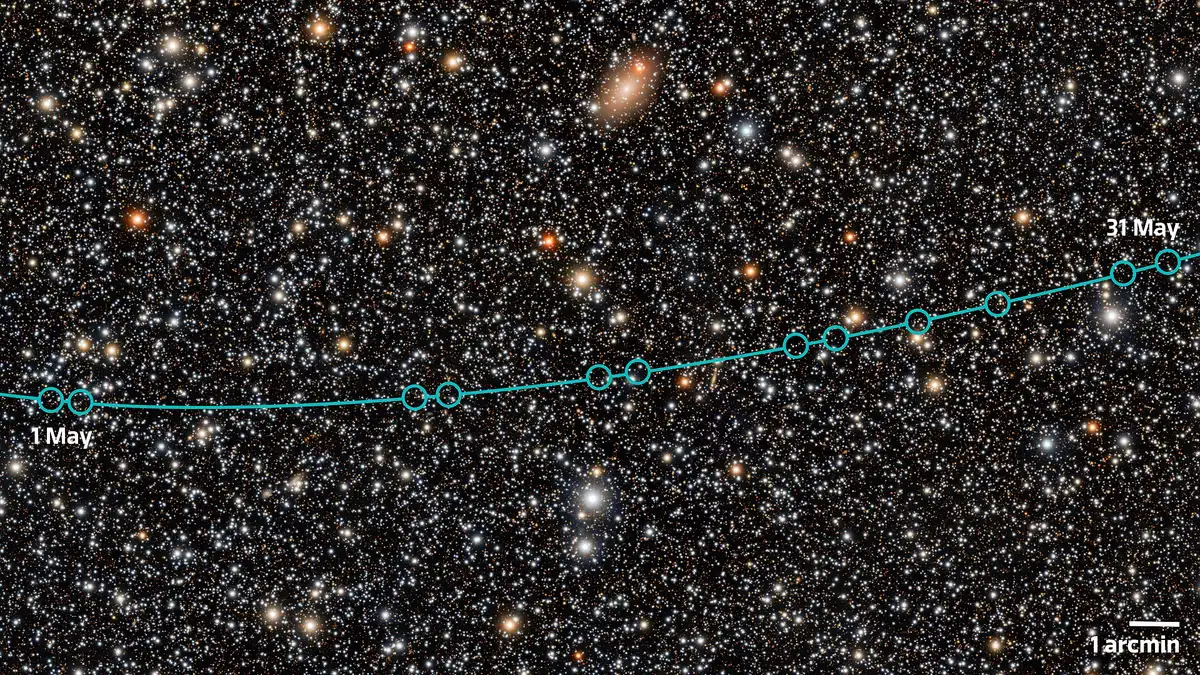
Mario Jurić of the University of Washington, who leads Rubin’s Solar System science, then searched Rubin’s catalogs and images and turned up 20 more observations, going back to 4 March. In all, Rubin recorded ED138 30 times on 20 nights between 4 March and 11 July 2026.
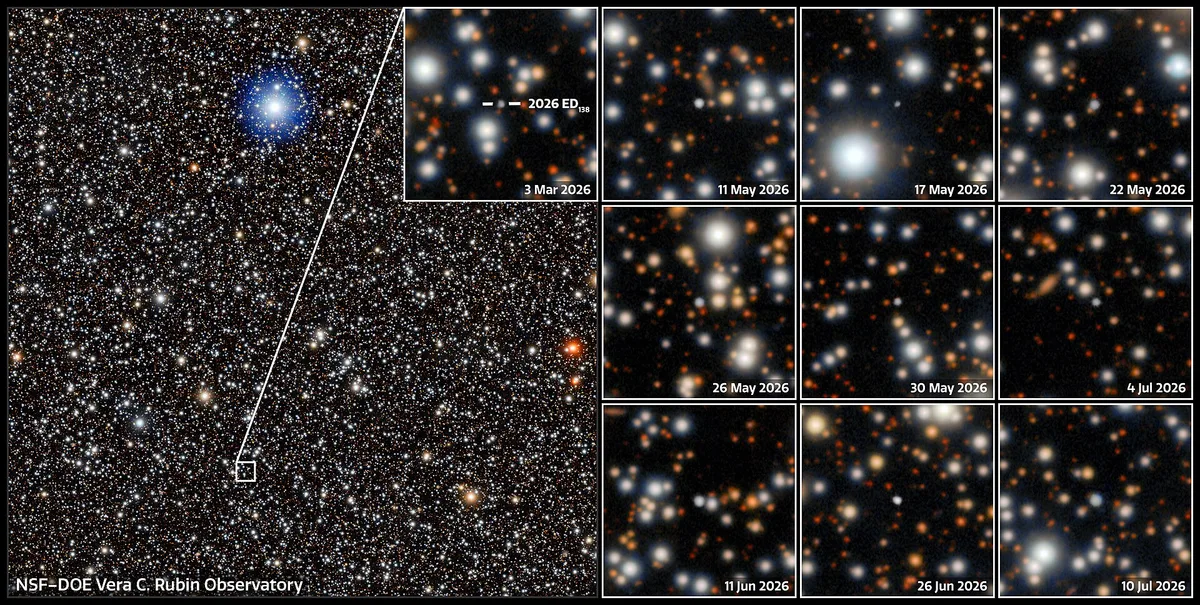
The trail goes back further. Using a precovery service run by the Asteroid Institute (“precovery” means finding a newly identified object in older images), the team found ED138 in archival images from the Dark Energy Camera on the 4-meter Blanco telescope in Chile, dating back to 2016, which gave them more than ten years of its orbit.
The Minor Planet Center of the IAU (International Astronomical Union) announced the discovery on 27 October in a Minor Planet Electronic Circular, and Holman and Jurić presented it that day at a press conference at the 58th annual Division for Planetary Sciences meeting in Spokane, Washington.
How far away is it, and how big?
ED138 is now about 46 au from the Sun. One au is the average Earth–Sun distance, about 150 million km (93 million miles), so that is roughly 6.9 billion km (4.3 billion miles), farther out than Pluto’s average of about 40 au. Anything orbiting the Sun beyond Neptune is a TNO (trans-Neptunian object), and ED138 is one.
Its orbit is tilted almost 25 degrees from the plane of the planets, which makes it a “hot classical” TNO; the team reads the tilt as a sign that Neptune’s gravity disturbed its original orbit.
The size estimate of 600 to 1,500 km comes from the object’s distance, its brightness and a guess at its albedo, the share of sunlight its surface reflects. The range is wide because the surface is still unknown: at the same brightness, a dark surface means a bigger object and a bright, icy one a smaller object. Jurić puts it at “roughly 1,000 kilometers across” and calls it “the largest trans-Neptunian object found in about 20 years”, but that 1,000 km is his rough figure, not a measurement.
Even the top of the estimate, 1,500 km, is smaller than Pluto:
| Detail | 2026 ED138 | Pluto |
|---|---|---|
| Status | Dwarf planet candidate | Dwarf planet (reclassified in 2006) |
| Distance from the Sun | About 46 au now | About 40 au on average |
| Diameter | 600–1,500 km (estimate) | About 2,377 km |
| Discovered | October 2026 (seen in images from 2016) | 1930 |
Why is it only a dwarf planet “candidate”?
The dwarf planet category dates from 2006, when the IAU defined what counts as a planet. As NASA (National Aeronautics and Space Administration) puts it, a planet must orbit the Sun, be mostly round, and be big enough for its gravity to have cleared away objects of similar size near its orbit. A dwarf planet passes the first two tests but not the third, which is why Pluto, long counted as the ninth planet, was reclassified in 2006.
So the big question for ED138 is whether it is round. Icy bodies this large are expected to be, and Rubin Observatory notes that being round is what sets a dwarf planet apart from other TNOs. But with a size estimate this wide, the team says infrared observations are needed to pin down how big ED138 is and to confirm that it is a dwarf planet. The announcement does not say who will make the final call or how long that will take.
If it is confirmed, ED138 would join the five dwarf planets the IAU recognizes: Pluto, Ceres, Eris, Haumea and Makemake. That is where the “sixth dwarf planet” headlines come from.
Why wasn’t something this big found sooner?
Because of where it sits. ED138 lies in a part of the sky close to the plane of the Milky Way, where millions of stars crowd the view, so to most telescopes it simply blended in.
Rubin gets around that with repetition and software. It photographs the whole southern sky again and again, and its algorithms sort through millions to billions of points of light to pick out the moving ones. Its camera, the largest digital camera ever built, is about the size of a small car and has 3,200 megapixels, roughly as many pixels as 260 modern phone camera sensors.
Rubin’s 10-year survey, the LSST (Legacy Survey of Space and Time), began in June 2026. ED138 is Rubin’s first dwarf planet candidate, and anyone can explore its orbit in three dimensions on Rubin’s Orbitviewer web app.
What do the words in this story mean?
This site saves one news story at a time and branches out into the words inside it. These are the first ones worth knowing.
| Word | What it means here |
|---|---|
| Dwarf planet | A body that orbits the Sun and is nearly round but has not cleared its orbit. The IAU recognizes five |
| Pluto | Called the ninth planet from its discovery in 1930 until it was reclassified in 2006 |
| Kuiper Belt | The region of icy bodies beyond Neptune, where Pluto orbits. Objects past Neptune are called TNOs |
| Astronomical unit (au) | The average Earth–Sun distance, about 150 million km. ED138 is now about 46 au away |
| Vera Rubin | The astronomer who provided the first convincing evidence for dark matter, and the observatory’s namesake |

Each word gets its own explainer, and the published ones are listed under “Branching out from this story” below.
In short
2026 ED138 is the Vera C. Rubin Observatory’s first dwarf planet candidate: an icy world beyond Neptune, now about 46 au from the Sun, estimated at 600 to 1,500 km across and traced in images back to 2016. Confirming it as a dwarf planet will take infrared observations that pin down its size.
Branching out from this story
 What is a dwarf planet, and how is it different from a planet?
 Why isn't Pluto a planet anymore, and when was it demoted?
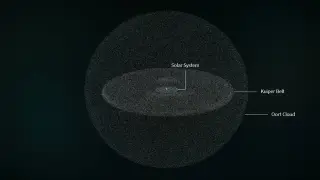 What is the Kuiper Belt, and how is it different from the Oort Cloud?
 What is an astronomical unit (AU), and how does it compare with light-years and parsecs?
 Who was Vera Rubin, the astronomer behind the observatory's name?
People also ask
Who discovered 2026 ED138, and when?
Matthew Holman of the Harvard & Smithsonian Center for Astrophysics spotted it on the evening of 13 October 2026, using a search code he built with Kevin Napier to sift Rubin Observatory data. The International Astronomical Union's Minor Planet Center announced the discovery on 27 October.
Is 2026 ED138 a dwarf planet?
Not yet. It is a dwarf planet candidate. At an estimated 600–1,500 km across it is expected to be round, but infrared observations are needed to pin down its size and confirm its status. If confirmed, it would join Pluto, Ceres, Eris, Haumea and Makemake.
How many dwarf planets are there?
The International Astronomical Union recognizes five: Pluto, Ceres, Eris, Haumea and Makemake. Ceres orbits in the asteroid belt between Mars and Jupiter, and the other four orbit beyond Neptune.
Sources
- Rubin Observatory - NSF–DOE Vera C. Rubin Observatory Reveals Its First Dwarf Planet Candidate in Our Solar System (27 Oct 2026)
- University of Washington News - Rubin Observatory reveals its first dwarf planet candidate in our solar system (27 Oct 2026)
- Rubin Observatory - LSST Camera
- NASA Science - Pluto & Dwarf Planets
- NASA Science - Pluto: Facts