Science & techIssue New dwarf planet candidate 2026 ED138: what did Rubin find beyond Pluto?
Q. What is the Kuiper Belt, and how is it different from the Oort Cloud?
The Vera C. Rubin Observatory has announced its first dwarf planet candidate, 2026 ED138, an icy world orbiting beyond Pluto. Icy worlds out there bring two names to mind: the Kuiper Belt and the Oort Cloud. So what exactly is the Kuiper Belt, and how is it different from the Oort Cloud?
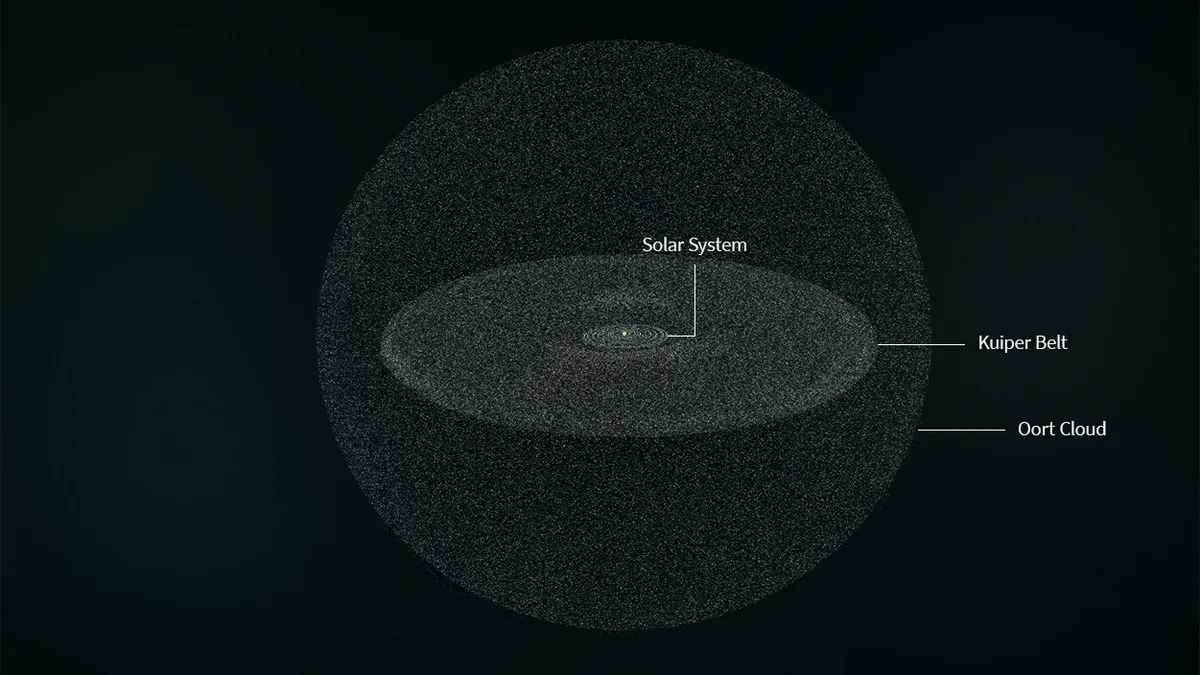
The short answer: the Kuiper Belt is a doughnut-shaped region of icy bodies just beyond Neptune, about 30 to 50 au (astronomical units) from the Sun, while the Oort Cloud is a far more distant shell of icy objects thought to surround the entire solar system. One au, the average Earth–Sun distance, is roughly 150 million km (93 million miles). Another key difference: the Kuiper Belt has been observed, but no one has ever seen the Oort Cloud directly.

What does “Kuiper Belt” mean, and who is it named after?
The Kuiper Belt is the zone beyond Neptune where small, icy bodies circle the Sun in a broad band. It is named after astronomer Gerard Kuiper, who published a paper in 1951 speculating about objects beyond Pluto. Kenneth Edgeworth wrote about similar ideas in the 1940s, which is why some astronomers call it the Edgeworth-Kuiper Belt.
The prediction came long before the proof. NASA (National Aeronautics and Space Administration) counts Pluto, discovered in 1930, as the first Kuiper Belt object, but Pluto and its moon Charon had no known neighbors out there until 1992. That year, David Jewitt and Jane Luu used the University of Hawaii’s 2.2-meter telescope on Mauna Kea to spot 1992 QB1, the first Kuiper Belt object found after Pluto. Their Kuiper Belt work later earned the pair a share of the 2012 Kavli Prize in Astrophysics.
Where is the Kuiper Belt, and how far away is it?
According to NASA, the Kuiper Belt’s inner edge begins at Neptune’s orbit, about 30 au from the Sun, and its main region ends around 50 au. That is roughly 4.5 to 7.5 billion km (2.8 to 4.6 billion miles). Even sunlight takes about four and a half hours to reach Neptune’s orbit.
The edge is not sharp. Overlapping the outer belt is the scattered disk: objects that Neptune’s gravity flung onto long, steeply tilted orbits reaching out to nearly 1,000 au. NASA describes the belt as more of a thick disk, like a doughnut, than a thin ring.
How is the Kuiper Belt different from the Oort Cloud?
The idea of the Oort Cloud dates to 1950, when Dutch astronomer Jan Oort proposed that some comets come from a vast, distant shell of icy bodies around the Sun. He was trying to explain long-period comets, which take more than 200 years to orbit the Sun. NASA places the cloud’s inner edge somewhere between 2,000 and 5,000 au and its outer edge between 10,000 and 100,000 au.
The shapes differ, too. Many Kuiper Belt objects orbit near the same flat plane as the planets, but Oort Cloud objects are thought to circle the Sun at every angle, forming a thick bubble, which is why NASA calls it a cloud rather than a belt. ESA (European Space Agency) notes that the Oort Cloud is so far away that it has never been seen directly. The Kuiper Belt is a doughnut we can observe; the Oort Cloud is a shell we infer from comets.
| Feature | Kuiper Belt | Oort Cloud |
|---|---|---|
| Distance from the Sun | About 30–50 au (main region) | Inner edge 2,000–5,000 au, outer edge 10,000–100,000 au (estimated) |
| Sunlight travel time | About 4.5 hours to Neptune’s orbit | 10–28 days to the inner edge, about 1.5 years to the outer edge |
| Shape | Thick doughnut near the planets’ plane | Spherical shell around the solar system |
| Observed? | Yes; more than 2,000 trans-Neptunian objects cataloged | No; theorized, never seen directly |
| Estimated population | Hundreds of thousands of objects wider than 100 km | Hundreds of billions to trillions of icy bodies |
| Typical comets | Short-period, especially Jupiter-family comets (under 20 years) | Long-period (200 to more than a million years) |
Comets tie the two together. Short-period comets orbit the Sun in 200 years or less. NASA says collisions in the Kuiper Belt chip off fragments that Neptune can nudge sunward, where Jupiter traps them in loops of 20 years or less as Jupiter-family comets. Most long-period comets are thought to come from the Oort Cloud.
What kinds of objects live in the Kuiper Belt?
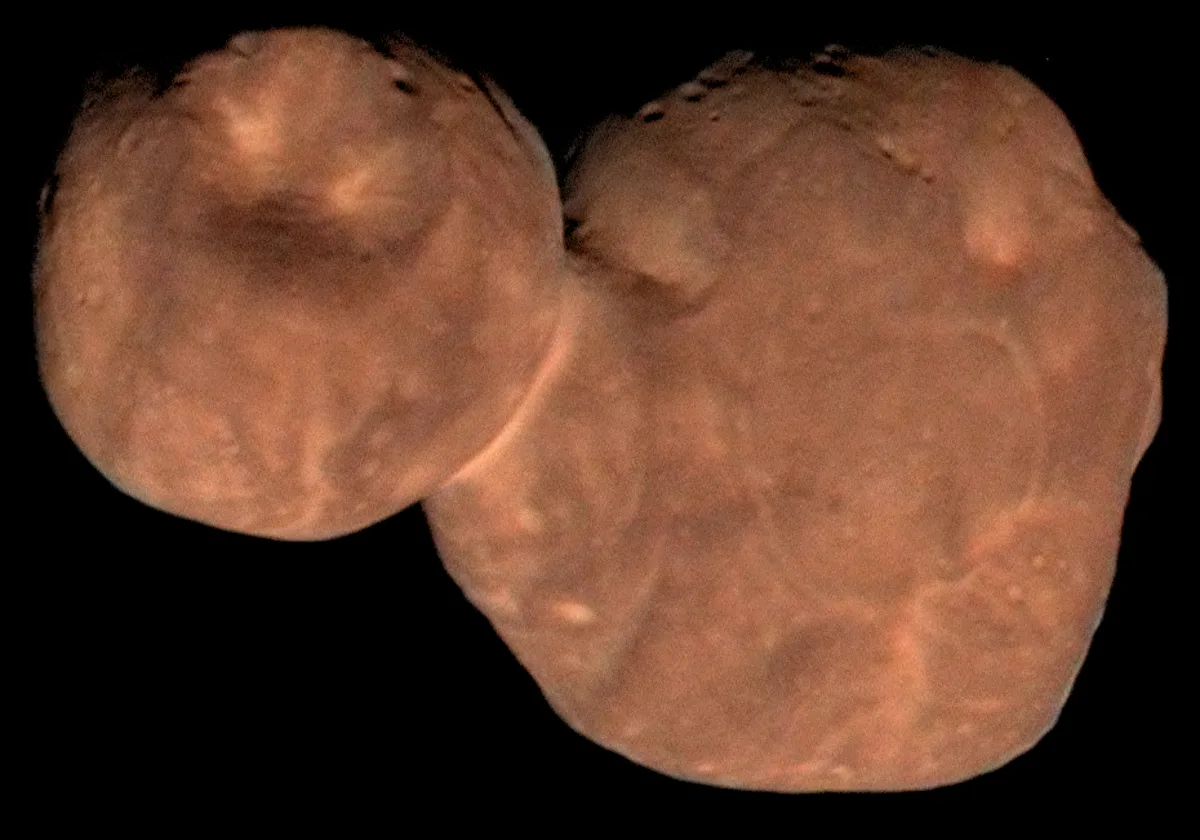
Kuiper Belt objects are mostly small and icy, and NASA estimates there are millions of them. The best known are the dwarf planets Pluto, Eris, Haumea and Makemake, all of which have moons. In 2019, NASA’s New Horizons spacecraft flew past Arrokoth, the most distant object a spacecraft has ever explored. Because they orbit beyond Neptune, these bodies are also called TNOs (trans-Neptunian objects).
Within the belt, astronomers sort objects by their orbits. A large share sit in the classical Kuiper Belt, which splits into “cold” and “hot” groups. Resonant objects move in step with Neptune: Pluto circles the Sun twice for every three orbits Neptune makes. The scattered disk objects mentioned above form another group.

Where does 2026 ED138 fit in the Kuiper Belt?
Back to the news. According to the Rubin Observatory, ED138 is currently about 46 au from the Sun, farther out than Pluto’s average distance of 40 au. That makes it a TNO, and it also places it inside the main Kuiper Belt as NASA describes it (about 30 to 50 au).
The telling number is its tilt. ED138’s orbit is tilted almost 25 degrees from the plane of the solar system, so the team classifies it as a hot classical TNO, which suggests that gravitational interactions with Neptune disturbed its original orbit. NASA explains the two groups this way: cold classical objects follow fairly circular orbits that are not tilted much, while hot classical objects have more elongated, tilted orbits because past encounters with Neptune pumped energy into them. “Hot” and “cold” describe how disturbed an orbit is, not temperature.
ED138 is still only a dwarf planet candidate. The team estimates it at 600 to 1,500 km across, based on its distance, brightness and estimated reflectivity, and says infrared observations are needed to pin down its size and confirm whether it is a dwarf planet.
In short
The Kuiper Belt is a thick band of icy bodies just beyond Neptune, about 30 to 50 au from the Sun. The Oort Cloud is a far larger shell, thousands to 100,000 au out, that no one has seen directly. The new candidate ED138 orbits at about 46 au on a tilted, hot classical path.
More from this issue
 New dwarf planet candidate 2026 ED138: what did Rubin find beyond Pluto?
 What is a dwarf planet, and how is it different from a planet?
 Why isn't Pluto a planet anymore, and when was it demoted?
 What is an astronomical unit (AU), and how does it compare with light-years and parsecs?
 Who was Vera Rubin, the astronomer behind the observatory's name?
People also ask
Is Pluto in the Kuiper Belt?
Yes. NASA calls Pluto, discovered in 1930, the first Kuiper Belt object ever found. It is a resonant object: it circles the Sun twice for every three orbits of Neptune.
Has anyone ever seen the Oort Cloud?
No. The European Space Agency says the Oort Cloud is so far away that it has never been seen directly. Jan Oort proposed it in 1950 to explain where long-period comets come from, and NASA describes it as theorized.
Has Voyager 1 reached the Oort Cloud?
Not yet. NASA says Voyager 1 won't enter the Oort Cloud for about 300 years, and it may not pass the cloud's outer edge for about 30,000 years.