Science & techIssue New dwarf planet candidate 2026 ED138: what did Rubin find beyond Pluto?
Q. Why isn't Pluto a planet anymore, and when was it demoted?
On 27 October 2026, the Vera C. Rubin Observatory in Chile announced its first dwarf planet candidate, 2026 ED138, an icy world found beyond Pluto. If you learned nine planets at school, the news may leave you wondering: why isn’t Pluto a planet anymore, and when exactly was it demoted?
The short answer: Pluto stopped being a planet on 24 August 2006, when the IAU (International Astronomical Union), meeting in Prague, voted to define the word “planet.” Pluto passes two of the definition’s three tests but fails the third, clearing the neighborhood around its orbit, so it became a dwarf planet.

When was Pluto discovered, and why was it the ninth planet?
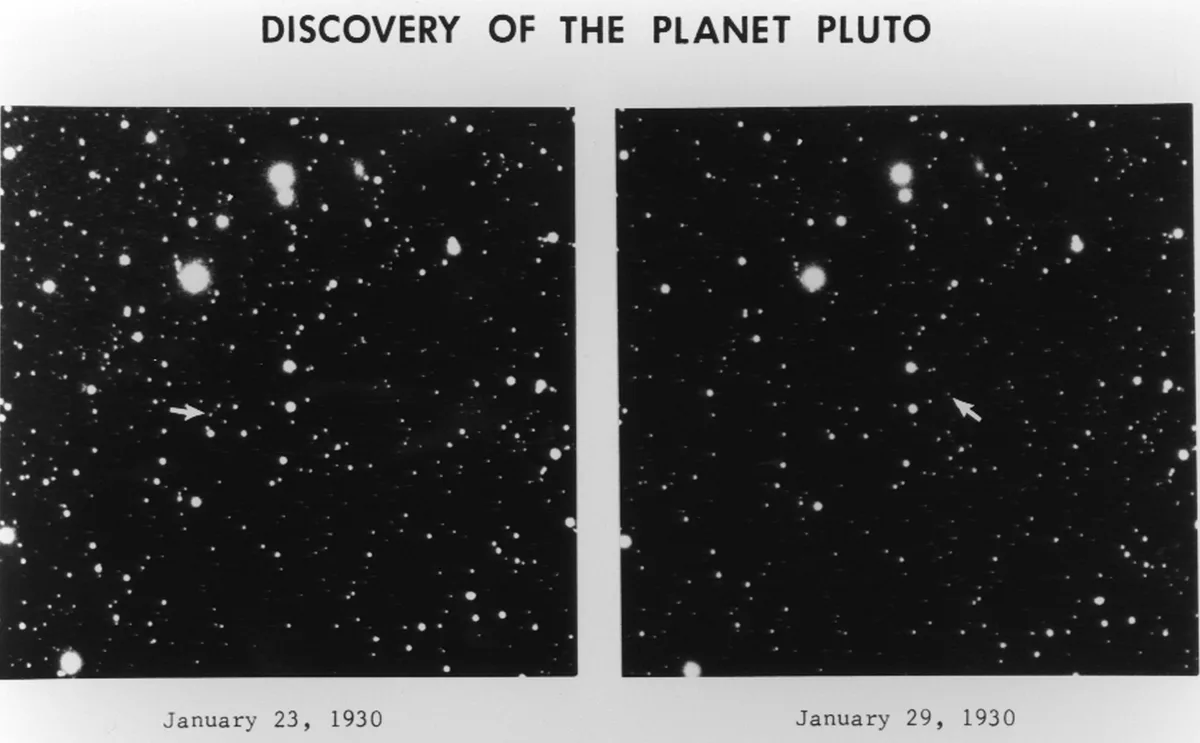
Pluto was found at Lowell Observatory in Flagstaff, Arizona, by observatory assistant Clyde Tombaugh. The observatory was hunting for “Planet X,” the ninth planet Percival Lowell had believed in. Tombaugh compared glass photographic plates of the same patch of sky taken on different dates, looking for a dot that moved. According to Lowell Observatory, he found Pluto on 18 February 1930, and the discovery was announced on 13 March, Percival Lowell’s birthday. Pluto went straight into the textbooks as the ninth planet.
The name came from Venetia Burney, an 11-year-old girl in Oxford, England. She suggested it to her grandfather, who passed it, through an Oxford astronomy professor, to Lowell Observatory, where it was chosen. Pluto is the Roman god of the underworld, the Greek Hades. Fun fact: the Korean name, myeongwangseong (冥王星), opens with a character also used for the land of the dead.
On 7 September 2006, two weeks after the vote, the Minor Planet Center, which catalogs small Solar System bodies, gave Pluto the number 134340. Here are the basics, from NASA (National Aeronautics and Space Administration) and the Minor Planet Center:
| Fact | Pluto |
|---|---|
| Status | Dwarf planet, since 2006 |
| Catalog name | (134340) Pluto |
| Discovered | 1930, by Clyde Tombaugh |
| Diameter (equator) | about 2,377 km (1,477 miles), a fifth of Earth’s |
| Average distance from the Sun | about 5.9 billion km (3.7 billion miles) |
| One orbit | about 248 years |
| Known moons | 5; the largest is Charon |
What changed, and why was Pluto demoted?
Pluto was always an odd planet. NASA points out that it is much smaller than Mercury, smaller even than some planetary moons, and that its largest moon, Charon, is about half its size. Its stretched, tilted orbit even brought it closer to the Sun than Neptune from 1979 to 1999.
In the early 1990s, astronomers began finding icy worlds in the Kuiper Belt, a doughnut-shaped region beyond Neptune. Some astronomers proposed seeing Pluto as the biggest member of that crowd rather than as a planet.
Then, in 2005, a team announced a “tenth planet.” Found in Palomar Observatory data from 2003, it was about the same size as Pluto and was later named Eris, after the Greek goddess of discord and strife. If Pluto was a planet, what was Eris? Pluto was demoted not because it changed, but because Pluto-sized discoveries forced astronomers to decide what a planet is.
When was Pluto demoted, and which test does it fail?
On 24 August 2006, at the closing ceremony of the IAU General Assembly in Prague, members passed resolutions on the definition of a planet and on Pluto. According to the IAU’s release that day, the definition passed by a great majority without a formal count, and the resolution on Pluto passed with 237 votes in favor, 157 against and 17 abstentions.

Under the definition, a planet is a body that orbits the Sun, has enough mass for its own gravity to pull it into a nearly round shape (hydrostatic equilibrium), and has cleared the neighborhood around its orbit. NASA describes that last test as whether a body has swept up or scattered away its nearby neighbors.

Pluto fails the third test. It shares the region beyond Neptune with many other icy bodies, and NASA notes that other objects might cross its path. The IAU made Pluto the prototype of a new category of trans-Neptunian objects, and the planet count dropped to eight, from Mercury to Neptune.
Could Pluto become a planet again?
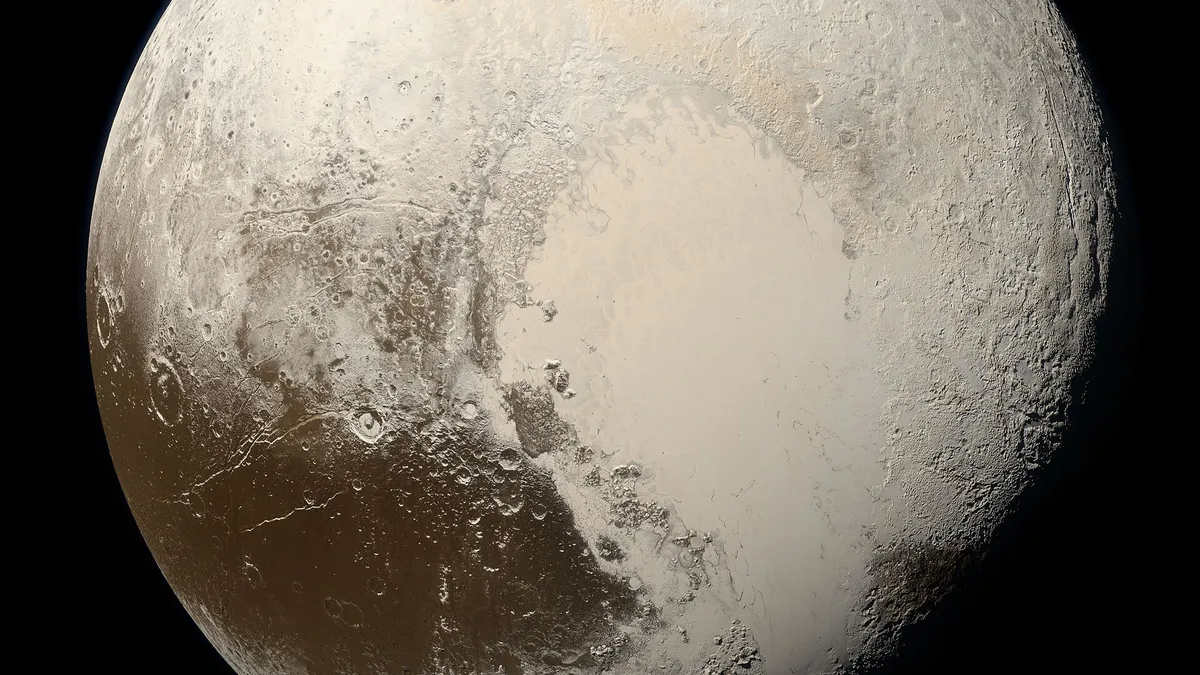
NASA’s New Horizons spacecraft left Earth in January 2006, when Pluto was still a planet, and on 14 July 2015 it became the first spacecraft to explore Pluto up close. It revealed a heart-shaped region, informally named Tombaugh Regio, and inside it icy plains with no impact craters that look no more than 100 million years old. NASA says scientists were especially surprised by how active Pluto’s surface still is.
Some scientists want the definition rethought. In 2018, a team led by planetary scientist Philip Metzger of the University of Central Florida reported that, in about 200 years of literature, only one publication, from 1802, had used orbit-clearing to classify planets. They argued that a body made round by its own gravity should count. New Horizons principal investigator Alan Stern was a co-author. NASA notes that not all astronomers agreed with the IAU, and it also lists objections to a roundness rule: it does not say how round is round, and distant objects are hard to measure.
Still, the IAU’s 2006 definition has not changed, and Pluto remains officially a dwarf planet. Rubin Observatory’s October 2026 announcement lists Pluto among the five dwarf planets the IAU recognizes.
How does the new candidate 2026 ED138 compare with Pluto?
According to Rubin Observatory, 2026 ED138 is now about 46 au (astronomical units) from the Sun; 1 au is the average Earth–Sun distance, about 150 million km. Pluto’s average distance is 40 au. Like Pluto, ED138 is a TNO (trans-Neptunian object), a body that orbits beyond Neptune.
Its estimated diameter is 600 to 1,500 km, smaller than Pluto’s 2,377 km. Icy bodies that big are expected to be round, the second test above, but more observations are needed to pin down its size and confirm it as a dwarf planet. If confirmed, it would join the five the IAU recognizes: Pluto, Ceres, Eris, Haumea and Makemake. Mario Jurić of the University of Washington, who leads Rubin’s Solar System science, called it “the largest trans-Neptunian object found in about 20 years.”
In short
Pluto lost its planet status on 24 August 2006, when the IAU decided that a planet must also clear the neighborhood around its orbit, a test Pluto fails. Its catalog name is now (134340) Pluto. Some scientists still argue for a roundness-based definition, but the IAU’s rule stands, and if 2026 ED138 is confirmed it will join Pluto as a dwarf planet.
More from this issue
 New dwarf planet candidate 2026 ED138: what did Rubin find beyond Pluto?
 What is a dwarf planet, and how is it different from a planet?
 What is the Kuiper Belt, and how is it different from the Oort Cloud?
 What is an astronomical unit (AU), and how does it compare with light-years and parsecs?
 Who was Vera Rubin, the astronomer behind the observatory's name?
People also ask
When did Pluto stop being a planet?
On 24 August 2006, at the International Astronomical Union's General Assembly in Prague. Pluto had been counted as the ninth planet for 76 years, since its discovery in 1930.
Will Pluto ever be a planet again?
Only if the International Astronomical Union changes its 2006 definition, and it has not. Some scientists, including New Horizons leader Alan Stern, argue that any body made round by its own gravity should count as a planet.
How big is Pluto?
About 2,377 km (1,477 miles) across at the equator, according to NASA, roughly a fifth of Earth's width. It is much smaller than Mercury and smaller than some planetary moons.
Sources
- IAU - IAU 2006 General Assembly: Result of the IAU Resolution votes (2006-08-24)
- NASA Science - What is a Planet?
- NASA Science - Pluto: Facts
- Minor Planet Center - (134340) Pluto
- UCF News - Pluto a Planet? New Research from UCF Suggests Yes (2018)
- Lowell Observatory - This Week in Astronomy History: March 8-14
- NASA Science - Venetia Burney Phair (1918-2009)
- NASA JPL - Small-Body Database: 134340 Pluto