Science & techIssue New dwarf planet candidate 2026 ED138: what did Rubin find beyond Pluto?
Q. What is an astronomical unit (AU), and how does it compare with light-years and parsecs?
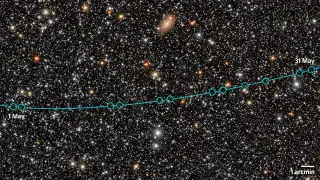
Rubin Observatory’s first dwarf planet candidate, 2026 ED138, is currently about 46 au (astronomical units) from the Sun, a little beyond Pluto’s average distance of 40 au. What exactly is an astronomical unit, and how does it compare with light-years and parsecs?
The short answer: an astronomical unit is a unit of length based on the average distance between Earth and the Sun, fixed since 2012 at exactly 149,597,870,700 meters, about 149.6 million km. A light-year, the distance light travels in a year, is about 63,241 au, and a parsec is about 3.26 light-years, or about 206,265 au. Distances inside the solar system are usually given in au, and distances to stars and galaxies in light-years or parsecs.

Why is the Earth–Sun distance the yardstick?
Long before anyone could measure planetary distances in kilometers, astronomers could work out how many times farther from the Sun a planet was than Earth. So the Earth–Sun distance became 1, and other distances were multiples of it. The IAU (International Astronomical Union), which sets names and standards in astronomy, says accurate distance ratios were the unit’s original purpose.
The catch was the length of that 1. Under the IAU’s 1976 definition, the au was tied to the Gaussian gravitational constant (used to calculate solar system motions), so its length in meters had to be measured; the IAU’s 2009 value, 149,597,870,700 meters give or take 3, was an average of recent estimates. Once distances in the solar system could be measured directly and very precisely, the IAU’s General Assembly in Beijing in August 2012 turned that number into a definition. Since 2012, 1 au is not a measurement that shifts with each new observation but a fixed length of exactly 149,597,870,700 meters.
That also means 1 au is not exactly today’s Earth–Sun distance. Earth’s orbit is a slightly stretched ellipse, and an Earth fact sheet from NASA (National Aeronautics and Space Administration) puts our distance from the Sun between about 147.1 million and 152.1 million km over the year. The au is a fixed mark near the middle of that range.
Is it AU or au?
You will see both. Because various symbols were in use, the IAU’s 2012 resolution recommended a single one, lowercase au, and Rubin’s release follows it (“46 au”). NASA’s Jet Propulsion Laboratory goes further: its glossary calls uppercase AU technically incorrect. Even so, AU is still everywhere, including the IAU’s own education glossary, and it means the same unit.
How does an astronomical unit compare with a light-year?
A light-year (ly) sounds like a unit of time, but it is a distance: how far light travels in a vacuum in one year. Astronomers count that year as a Julian year of 365.25 days, and so does the conversion table of NIST (National Institute of Standards and Technology). Multiply the speed of light, exactly 299,792,458 meters per second, by the 31,557,600 seconds in that year and you get 9,460,730,472,580.8 km, about 9.46 trillion km, or about 63,241 au.
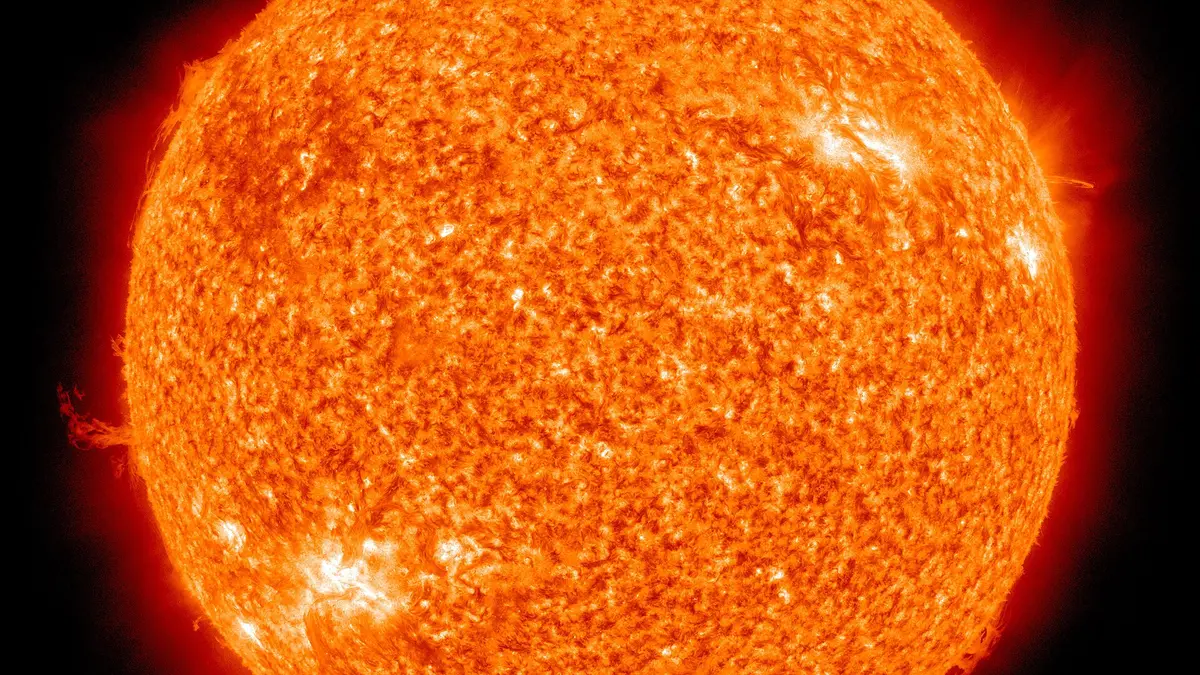
Run it the other way and the au becomes a travel time for light. Divide 149,597,870,700 m by the speed of light and you get 499.0 seconds: sunlight takes about 8 minutes 19 seconds to reach Earth, the figure often rounded to 8 minutes 20 seconds. Because the real Earth–Sun distance changes, the actual trip ranges from about 8 minutes 11 seconds to 8 minutes 27 seconds over the year.
Light-years turn huge distances into manageable numbers, which is why they are common in popular writing. Research leans the other way: the IAU’s Office of Astronomy for Education calls the parsec the professional astronomer’s preferred measure of distance, more common in the literature than the light-year.
How does the parsec relate to the astronomical unit?
The parsec (pc) is built directly on the au. One parsec is the distance at which 1 au would appear to span one arcsecond, 1/3600 of a degree. That angle is a star’s parallax, measured from the small shift in the star’s position as Earth goes around the Sun, and the name parsec blends parallax and second (of arc). Distance in parsecs is simply 1 divided by the parallax in arcseconds, so Sirius, about 8.6 light-years or 2.6 parsecs away, has a parallax of about 0.38 arcsecond.
Because the definition is pure geometry, a parsec is exactly 648,000/π au, about 206,265 au, as the IAU spelled out in a 2015 resolution. With the au fixed in meters, the parsec comes out at about 30.86 trillion km, or about 3.26 light-years.
Here are the three units side by side, calculated from their definitions and rounded:
| Unit (symbol) | Definition | In km | In au |
|---|---|---|---|
| Astronomical unit (au) | Fixed at 149,597,870,700 m | about 149.6 million | 1 |
| Light-year (ly) | Distance light travels in a Julian year (365.25 days) | about 9.46 trillion | about 63,241 |
| Parsec (pc) | Distance at which 1 au spans 1 arcsecond | about 30.86 trillion | about 206,265 |
So 1 parsec is about 3.26 light-years, and 1 light-year is about 0.31 parsec. The figures match NIST’s conversion table.
How far is 46 au, and how long does light take to get there?
Back to the news. Rubin Observatory puts 2026 ED138 at about 46 au from the Sun right now, while Pluto’s average distance is 40 au. Multiply 46 by 149,597,870,700 m and you get about 6.88 billion km (about 4.28 billion miles), or roughly 6.9 billion km. At that distance, sunlight needs about 6 hours 23 minutes to reach ED138. Light that leaves the Sun at noon gets there at about 6:23 in the evening. For Pluto’s average 40 au, the trip takes about 5 hours 33 minutes.

In light-years, 46 au is about 0.00073 ly; in parsecs, about 0.00022 pc. All those zeros are why the au rules inside the solar system: Earth is 1, Neptune about 30 and ED138 about 46. ED138 is still only a candidate, though; infrared observations are needed to pin down its size and confirm whether it is a dwarf planet.
In short
An astronomical unit is a length based on the average Earth–Sun distance, fixed in 2012 at exactly 149,597,870,700 m, and the IAU writes it as lowercase au. A light-year is about 63,241 au and a parsec about 206,265 au, or 3.26 light-years. Dwarf planet candidate 2026 ED138, at about 46 au, is roughly 6.9 billion km from the Sun, a trip of about 6 hours 23 minutes for sunlight.
More from this issue
 New dwarf planet candidate 2026 ED138: what did Rubin find beyond Pluto?
 What is a dwarf planet, and how is it different from a planet?
 Why isn't Pluto a planet anymore, and when was it demoted?
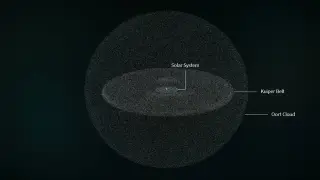 What is the Kuiper Belt, and how is it different from the Oort Cloud?
 Who was Vera Rubin, the astronomer behind the observatory's name?
People also ask
How many kilometers is 1 AU?
Exactly 149,597,870.7 km, or about 149.6 million km (about 93 million miles). The IAU fixed it at 149,597,870,700 meters in 2012. Light covers that distance in about 499 seconds, or 8 minutes 19 seconds.
Is a parsec bigger than a light-year?
Yes. One parsec is about 3.26 light-years, or about 206,265 au. It is the distance at which 1 au would appear to span one arcsecond, 1/3600 of a degree.
Should you write AU or au?
The IAU recommends lowercase au as the single symbol for the astronomical unit (Resolution B2, 2012), and NASA's JPL glossary calls uppercase AU technically incorrect. AU is still widely used, and both mean the same unit.
Sources
- IAU - List of Resolutions (2012 Resolution B2: re-definition of the astronomical unit of length; 2015 Resolution B2)
- NASA JPL Solar System Dynamics - Glossary: au
- NIST - Guide to the SI, Appendix B.8: Factors for Units Listed Alphabetically
- IAU Office of Astronomy for Education - Glossary: Parsec
- NASA Chandra X-ray Observatory - Sirius A & B (26 Sep 2000)
- Rubin Observatory - NSF–DOE Vera C. Rubin Observatory Reveals Its First Dwarf Planet Candidate in Our Solar System (2026-10-27)
- NASA JPL - PIA23645: Pale Blue Dot Revisited (12 Feb 2020)