Science & techIssue New dwarf planet candidate 2026 ED138: what did Rubin find beyond Pluto?
Q. What is a dwarf planet, and how is it different from a planet?
On October 27, the Vera C. Rubin Observatory in Chile revealed its first dwarf planet candidate, 2026 ED138, an icy world beyond Pluto, and headlines soon called it a possible sixth dwarf planet. Which raises a basic question. What exactly is a dwarf planet, and how is it different from a planet?
The short answer: a dwarf planet orbits the Sun and is massive enough for its own gravity to make it nearly round, but it has not cleared other objects out of its orbital neighborhood. That third test is the only one that separates it from a planet. The IAU (International Astronomical Union), the worldwide body of astronomers that wrote the definition, recognizes five: Ceres, Pluto, Haumea, Makemake and Eris.

What is the official definition of a dwarf planet?
The definition comes from the IAU’s 26th General Assembly, held in Prague in August 2006. Its Resolution B5, “Definition of a Planet in the Solar System,” says a planet is a body that:
- orbits the Sun;
- has enough mass that its own gravity overcomes the stiffness of its material and pulls it into a nearly round shape;
- has cleared the neighborhood around its orbit.
A dwarf planet meets the first two conditions, fails the third, and is not a satellite, so a moon never counts, however big and round it is. Everything else orbiting the Sun became a “small Solar System body”: most asteroids, most objects beyond Neptune, and comets.
The IAU called planets and dwarf planets two distinct classes of objects, so a dwarf planet is not a kind of planet, unlike a dwarf star, which is still a star. The resolution also sets no size cutoff; what counts is the shape a body’s own gravity gives it.
How is a dwarf planet different from a planet?
It comes down to test three. NASA (National Aeronautics and Space Administration) puts it plainly: a planet must be big enough that its gravity has cleared away other objects of similar size near its orbit. Earth, for example, does not share its orbit with another Earth-sized world.
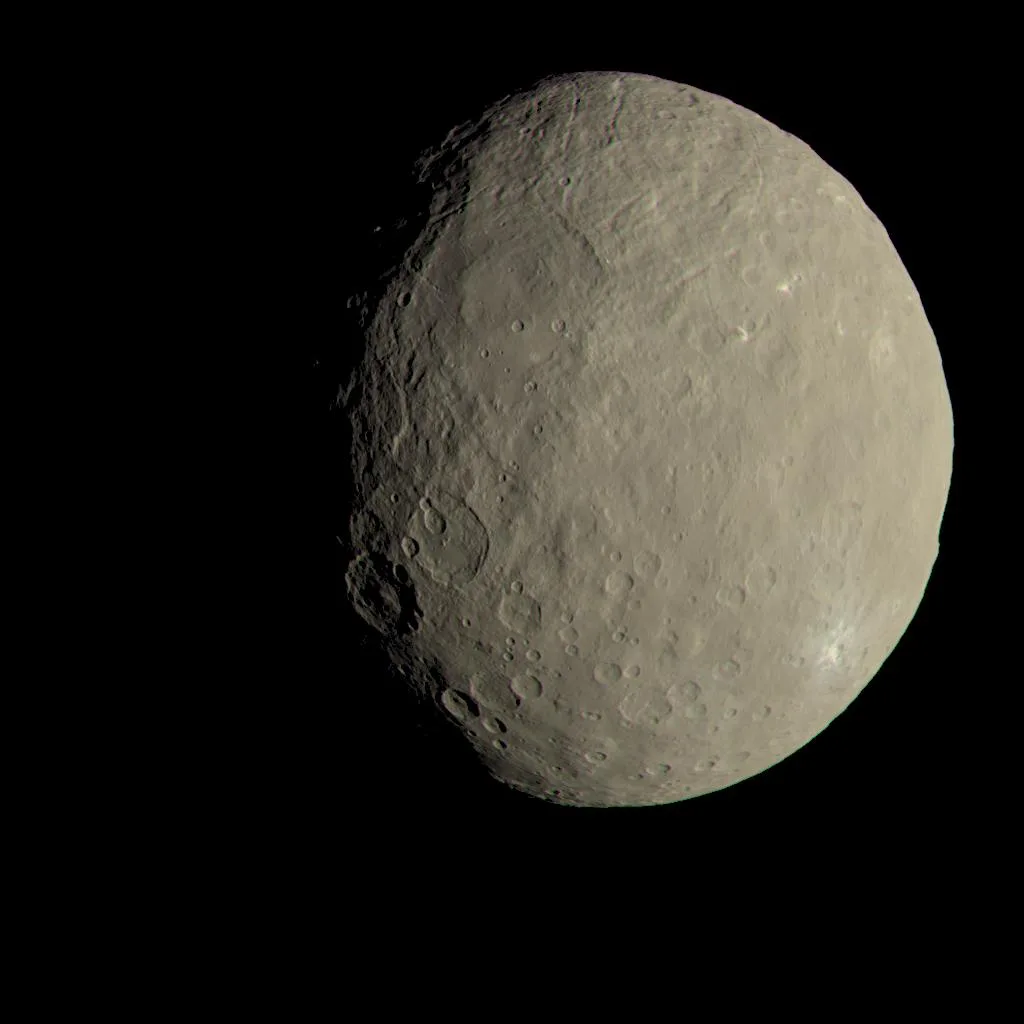
Ceres shows what failing looks like. It is the largest object in the asteroid belt between Mars and Jupiter and, according to NASA, holds about a quarter of the belt’s total mass. Yet it shares the belt with countless asteroids. Discovered in 1801, Ceres was once classed as a planet, then spent many years as an asteroid before becoming a dwarf planet in 2006.
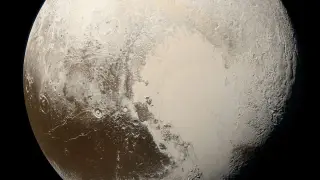
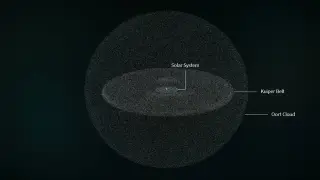
Pluto orbits in the Kuiper Belt, a doughnut-shaped region of icy bodies beyond Neptune, where astronomers kept finding worlds much like it. NASA says the discovery of Eris in 2005 helped trigger the debate that ended with Pluto’s reclassification as a dwarf planet in 2006. A dwarf planet is big enough to be round, but not big enough to rule its orbit.
How many dwarf planets are there?
The IAU’s first dwarf planets in 2006 were Ceres, Pluto and an object then known by the temporary name 2003 UB313, now Eris. Haumea and Makemake were added later, and NASA says the IAU has recognized five so far. Distances below are in kilometers and in au (astronomical units); 1 au is the average Earth–Sun distance, about 150 million km.
| Dwarf planet | Where it orbits | Diameter | Average distance from the Sun | Worth knowing |
|---|---|---|---|---|
| Ceres | Asteroid belt, between Mars and Jupiter | about 950 km | 413 million km (2.8 au) | Largest object in the asteroid belt |
| Pluto | Kuiper Belt | about 2,377 km | 5.9 billion km (39 au) | Five moons; Charon is about half Pluto’s size |
| Haumea | Kuiper Belt | about 1,740 km at the equator | 6.5 billion km (43 au) | Spins once every 4 hours; oval-shaped |
| Makemake | Kuiper Belt | about 1,430 km | 6.8 billion km (45.8 au) | Second-brightest Kuiper Belt object, after Pluto |
| Eris | Out beyond the Kuiper Belt | about 2,400 km | 10 billion km (68 au) | Nearly Pluto’s size; one moon, Dysnomia |
All figures in the table come from NASA.

What do dwarf planets have in common?
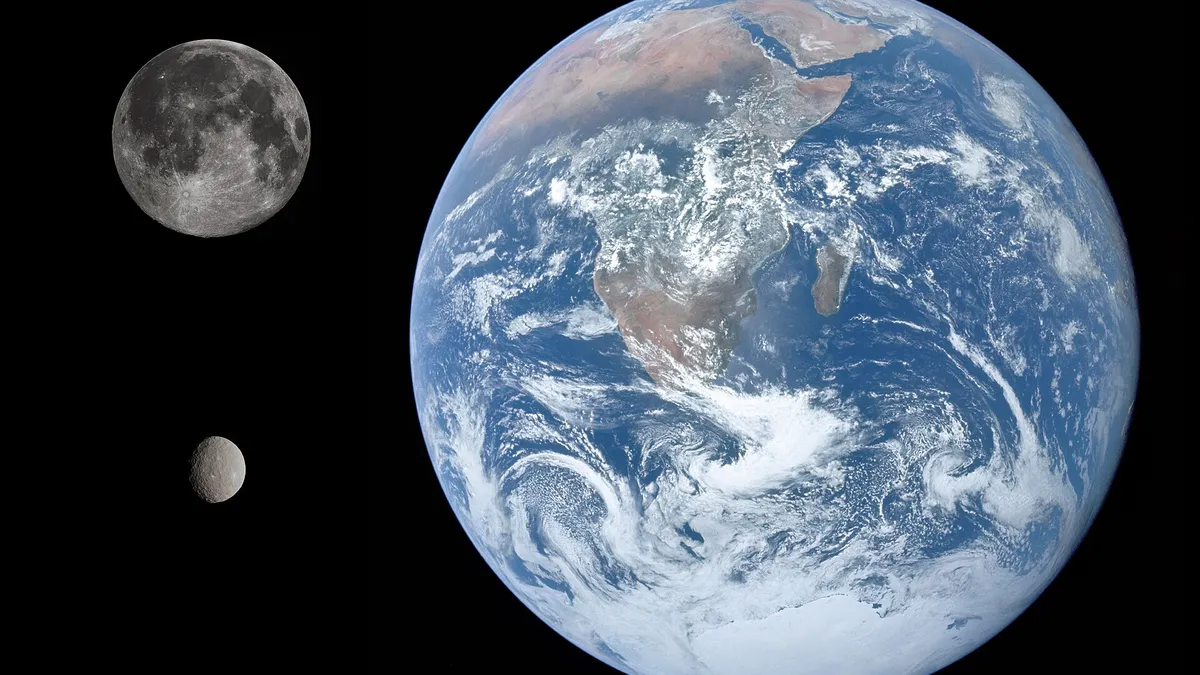
Line the five up and a pattern appears. They are small: even Pluto and Eris are smaller than Earth’s Moon. Apart from Ceres they are also far away, beyond Neptune’s orbit at about 30 au, which makes for long years: about 248 Earth years for Pluto and 557 for Eris, against 4.6 for Ceres.
Ice is common out there. NASA reports frozen methane and ethane on Makemake and says Ceres may be as much as 25% water. So are moons: Pluto has five, Haumea two, and Eris and Makemake one each.
And “nearly round” does not mean perfectly round. Haumea spins once every four hours, so fast that NASA says it looks like a football, yet it is one of the five.
Is 2026 ED138 a dwarf planet?
Not yet. It is a candidate, and it has company. In 2006 the IAU already had a dozen candidates on its dwarf planet watchlist, and NASA reports that the IAU says there may be more than a hundred dwarf planets still to be found. Some researchers use the label beyond the official five: in 2023 ESA (European Space Agency) announced an unexpected ring around Quaoar, a world beyond Neptune about 555 km in radius, and called it a dwarf planet. Quaoar is still not on the IAU’s list.
ED138 is now about 46 au (roughly 6.9 billion km) from the Sun. The open question is whether it is big enough to be round. Rubin’s team estimated its diameter at 600 to 1,500 km from its distance, its brightness and an estimated albedo, the share of sunlight its surface reflects. The range is wide because brightness alone cannot tell a large dark object from a small bright one. Even the top of that range is smaller than Pluto.
Mario Jurić of the University of Washington, Rubin’s Solar System lead scientist, described it as “roughly 1,000 kilometers across” and “the largest trans-Neptunian object found in about 20 years.” Icy bodies this large are expected to be round, but Rubin says infrared observations are needed to pin down the size and confirm that it is a dwarf planet. Until follow-up observations narrow down its size, 2026 ED138 remains a candidate. If it is confirmed, it would join the five dwarf planets the IAU recognizes.
In short
A dwarf planet orbits the Sun and is round under its own gravity, but unlike a planet it has not cleared its orbital neighborhood, and it is not a moon. The IAU recognizes five, Ceres, Pluto, Haumea, Makemake and Eris, and all but Ceres orbit beyond Neptune. 2026 ED138 could join them once its size is confirmed.
More from this issue
 New dwarf planet candidate 2026 ED138: what did Rubin find beyond Pluto?
 Why isn't Pluto a planet anymore, and when was it demoted?
 What is the Kuiper Belt, and how is it different from the Oort Cloud?
 What is an astronomical unit (AU), and how does it compare with light-years and parsecs?
 Who was Vera Rubin, the astronomer behind the observatory's name?
People also ask
How many dwarf planets are there?
The IAU officially recognizes five: Ceres, Pluto, Haumea, Makemake and Eris. According to NASA, the IAU says there may be many more, perhaps more than a hundred, still waiting to be found, and 2026 ED138 is the newest candidate.
Is a dwarf planet a planet?
No. The IAU's 2006 definition treats planets and dwarf planets as two distinct classes of objects. A dwarf planet passes two of the three tests for a planet, orbiting the Sun and being nearly round, but fails the third: it has not cleared the neighborhood around its orbit.
What is the difference between a dwarf planet and an asteroid?
A dwarf planet is massive enough for its own gravity to pull it into a nearly round shape. Most asteroids are not, so the IAU groups them with comets and most objects beyond Neptune as small Solar System bodies. Ceres was called an asteroid for many years before it was classified as a dwarf planet in 2006.