Science & techIssue Misiorowski's 103.5 mph first pitch: what World Series record did he break?
Q. How is pitch speed measured: radar gun or Statcast?
The 103.5 mph first pitch of the World Series from Milwaukee’s Jacob Misiorowski reached home plate in well under half a second, yet its speed was on screen moments later. So how is pitch speed measured, and what is the difference between a radar gun and Statcast?
The short answer: a radar gun measures how much radio waves change in frequency when they bounce off the moving ball (the Doppler effect), while MLB’s Statcast films the ball with high-speed cameras at 300 frames a second and calculates its speed from its position. The speed MLB (Major League Baseball) publishes is the ball’s top speed, at the moment it leaves the pitcher’s hand.

How does a radar gun work?
You know the Doppler effect from ambulances: the siren sounds high as one races toward you and drops as it passes. The approaching vehicle squeezes its sound waves together, so more reach your ear each second and you hear a higher note.
A radar gun does the same with radio waves. They bounce off the oncoming ball and return at a slightly higher frequency. The faster the ball, the bigger the shift, and the gun’s computer turns that shift into a speed.
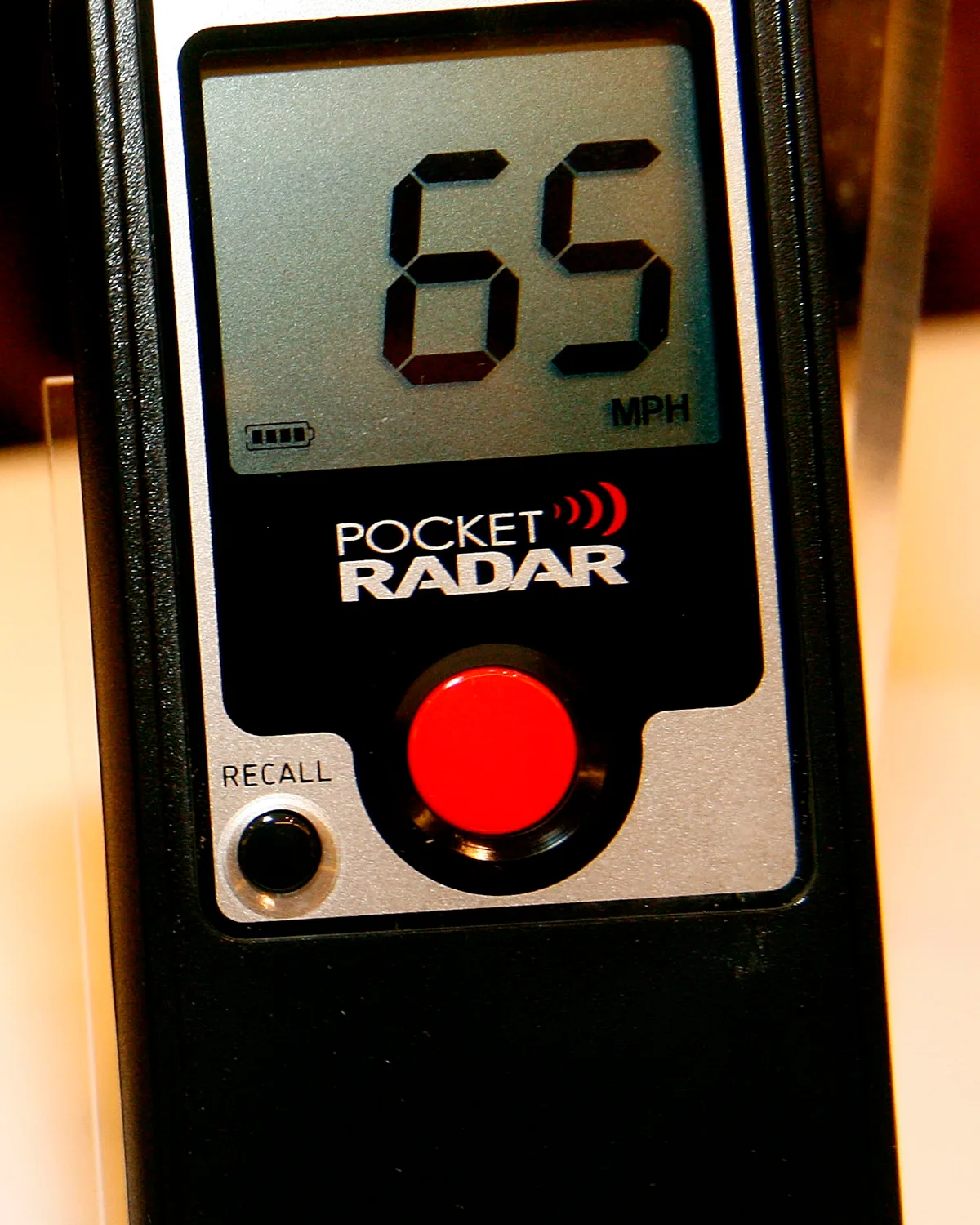
The shift is tiny. One baseball radar gun’s manual lists a frequency of 24.125 GHz, about 24 billion cycles a second, and by our calculation a 103.5 mph pitch sends the waves back roughly 7,400 cycles a second higher.
What is Statcast, and how is it different from a radar gun?
Statcast is MLB’s tracking system, installed in all 30 ballparks in 2015. It follows pitches, batted balls and players.
League-wide pitch tracking began in 2008 with PITCHf/x, a camera-based system. Statcast tracked pitches with TrackMan, a radar, through 2019, then switched in 2020 to Hawk-Eye, the camera system best known for instant replay in tennis. Each club now has 12 Hawk-Eye cameras, and the five that follow pitches and bats have shot 300 frames per second since 2023, up from 100. Filming the ball from several angles pins down its position in three dimensions; the change in that position gives its speed and path.
| Radar gun | Camera tracking (Statcast today) | |
|---|---|---|
| How it measures | Frequency shift of reflected waves | Ball position seen by several cameras |
| What it measures | Mainly speed toward the gun | Speed, spin, movement, batted balls |
| Weak spot | Reads low from an angle | Fixed in the ballpark; cannot travel |
| Typical users | Scouts, amateur games, practice | MLB official stats and broadcasts |
Is pitch speed measured out of the hand or at the plate?
MLB’s glossary defines velocity as a pitch’s maximum speed at any point between release and home plate. Air drag only slows a ball down once it has been thrown, so the top speed always comes at release. MLB’s official pitch speed is therefore release speed: how fast the ball is moving as it leaves the pitcher’s hand.
How much speed is lost? In a 2009 paper, physicist David Kagan of California State University, Chico, worked through the pitch Barry Bonds hit for his record 756th home run in 2007. It left the pitcher’s hand at 84.71 mph and crossed the plate at 77.2 mph, almost 9% slower, in less than half a second.
Earlier, PITCHf/x usually reported each pitch’s speed 50 feet from the back tip of home plate, a little after release, so its numbers ran slightly low. When MLB switched its official speeds to Statcast in 2017, MLB senior data architect Tom Tango said in an Associated Press report that Statcast readings were about 0.6 mph faster on average. The pitchers had not changed; the measuring point had.
Why do the scoreboard, TV and a scout’s gun show different speeds?
A radar gun only sees the part of the ball’s motion that points straight at it, so a gun off to the side reads low. The angle chart in the same manual shows a true 100 mph pitch reading 98.5 mph at 10 degrees and 86.6 mph at 30 degrees. That is why scouts sit behind home plate.
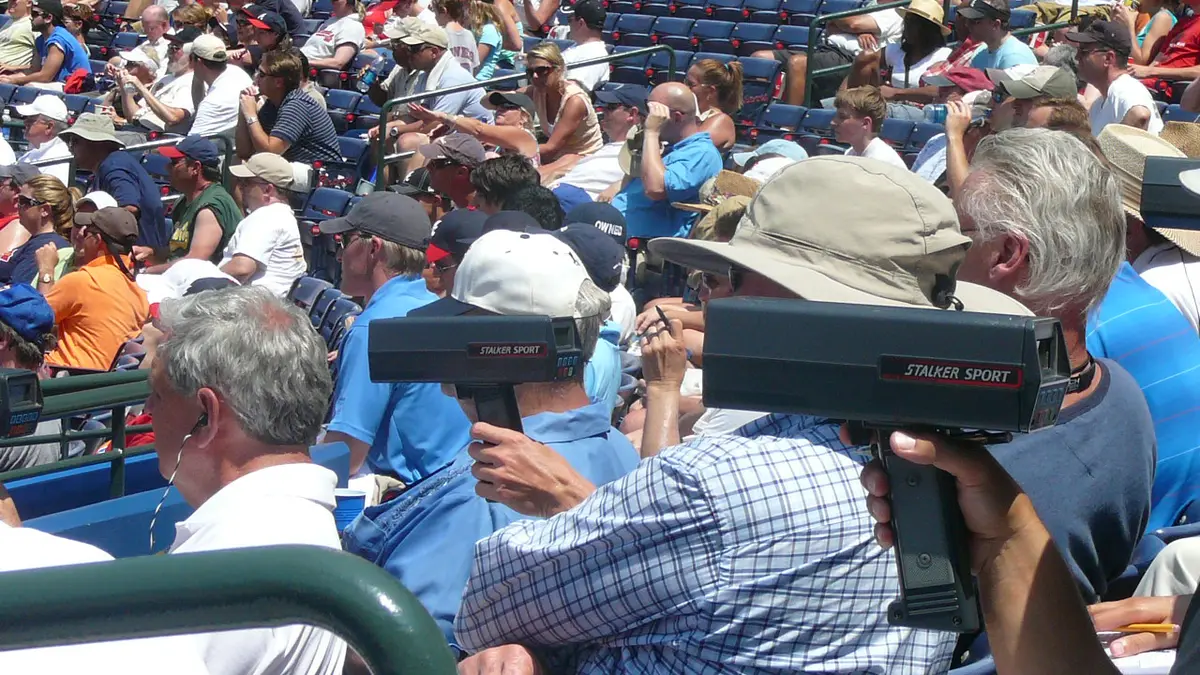
Timing matters too. The manual warns that guns used side by side, as in a row of scouts, can lose sensitivity, miss the ball out of the hand and catch it only after it has slowed. And the sources differ: MLB broadcasts and ballpark scoreboards get the league’s tracking numbers, while each scout reads their own gun.
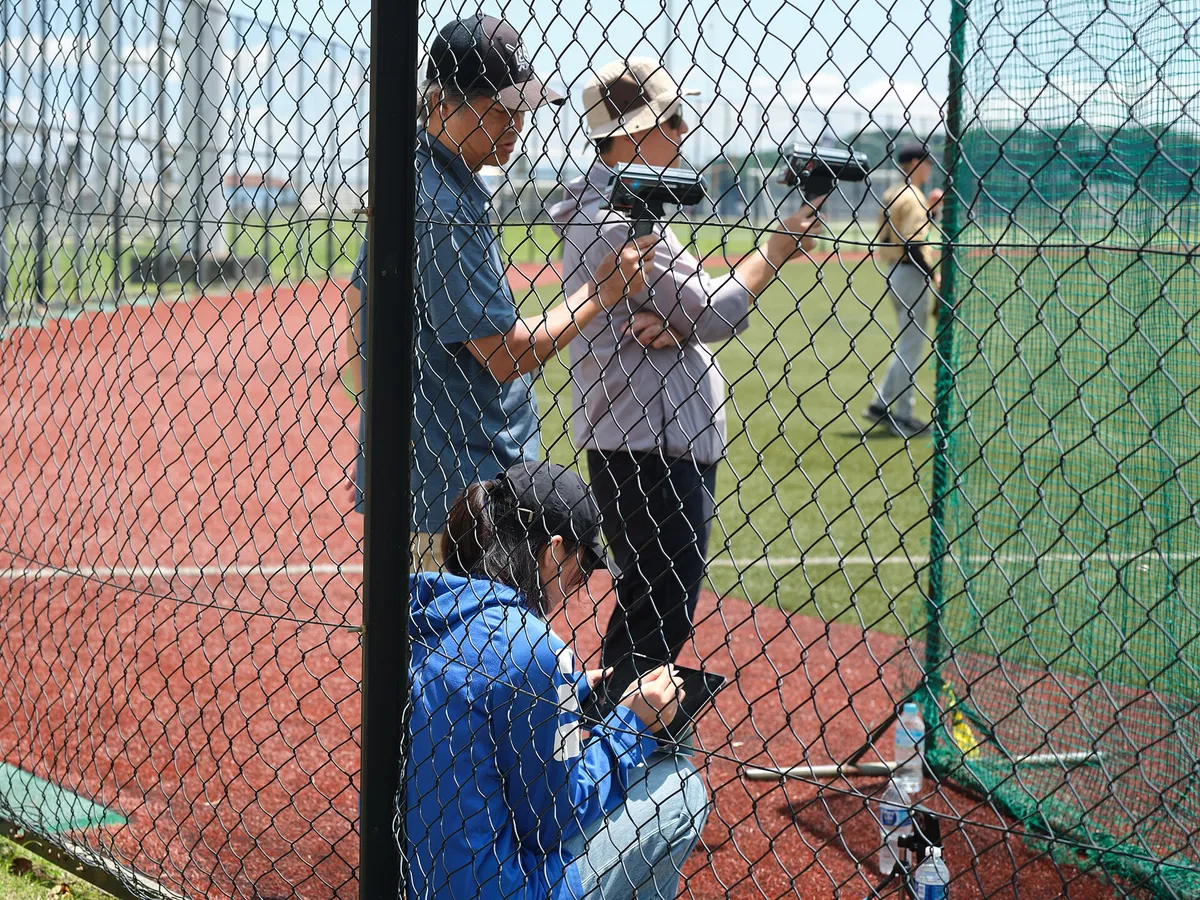
Phone apps and batting-cage machines obey the same physics. An app that times the ball on video divides distance by time, so it gives the average speed over the flight, below release speed. For a 75 mph pitch over about 56 feet, one frame off at 30 frames a second shifts the result by about 5 mph; at 240 frames a second, by under 1 mph. Cage machines also vary with mounting angle and calibration, so treat them as fun, not official. The same pitch can show different numbers depending on where, at what angle and with what it was measured.
How was the 103.5 mph World Series pitch measured?
MLB’s published speeds come from Statcast’s Hawk-Eye cameras and give each pitch’s top speed, at release. So Misiorowski’s 103.5 mph (about 166.6 km/h) is how fast the ball left his hand; it was slower by the time it reached Tampa Bay leadoff hitter Yandy Díaz.
MLB.com called it the fastest World Series pitch since pitch tracking began in 2008, the first season with pitch speeds for every MLB game. The previous mark was 103.2 mph, by Aroldis Chapman of the Chicago Cubs in Game 2 of the 2016 World Series. Since the tools have changed over the years, check how a number was measured before comparing eras.
In short
A radar gun reads the Doppler shift of radio waves bouncing off the ball; Statcast’s cameras track the ball’s position and calculate its speed. MLB’s official number is release speed, so the same pitch is slower at the plate and reads lower on a gun held at an angle.
More from this issue
 Misiorowski's 103.5 mph first pitch: what World Series record did he break?
 How do you convert mph to km/h, and what is 100 mph in km/h?
 Why is it called the World Series if only North American teams play?
 Average human reaction time: how do batters hit a 100 mph fastball?
 What is Tommy John surgery, and why do hard throwers need it?
People also ask
How accurate is a radar gun for baseball?
Accurate when it sits in line with the pitch, but it reads low from an angle. One manufacturer's manual shows a true 100 mph pitch reading 98.5 mph from 10 degrees off line and 86.6 mph from 30 degrees.
What is Statcast?
Statcast is MLB's tracking system, installed in every ballpark in 2015. It measures pitch speed, spin and movement, batted-ball speed and runners' sprint speed. Since 2020 it has used 12 Hawk-Eye cameras in each park.
Can a phone app measure pitch speed?
It can give a rough number. Apps that time the ball on video measure the average speed over the whole flight, which is lower than release speed, and a wrong distance or a low frame rate can throw the result off by several mph.
Sources
- MLB.com Glossary - Velocity (VELO)
- MLB.com Glossary - Pitch-tracking Era (since 2008)
- MLB.com Glossary - Statcast
- Stalker Radar - Stalker Sport 2 Operator Manual (PDF)
- David Kagan (California State University, Chico) - The Anatomy of a Pitch: Doing Physics with PITCHf/x Data (The Physics Teacher, 2009)
- AP (Sports Illustrated) - Speed bump: Radar readings up with MLB change to Statcast (2017)