Science & techIssue iPhone Duo release date and price: what's new in Apple's first foldable?
Q. What is a vapor chamber, and how does it cool a phone?
Apple’s announcement of iPhone Duo, its first foldable iPhone, keeps mentioning a part that sounds more like lab equipment than phone hardware: a vapor chamber, connected directly to the chip to keep it cool. So what exactly is a vapor chamber, and how is it different from a heat pipe?
The short answer: a vapor chamber is a thin, sealed metal plate with the air pumped out and a little water inside, and as that water evaporates and condenses over and over, it spreads the chip’s heat across the whole plate. A heat pipe works on the same principle, but as a tube it carries heat along a line, while a vapor chamber spreads it in every direction.

What is a vapor chamber made of?
Picture two thin metal sheets sealed together into a flat, hollow box. The inside walls are lined with a wick, a layer of fine metal mesh or metal powder that soaks up water like a sponge. A small amount of water goes in, the air is pumped out, and the box is sealed for good.
Why remove the air? Lower pressure makes water boil at a lower temperature, which is why water boils below 100°C (212°F) high in the mountains. A 2025 study in Nature Communications notes that heat pipes and vapor chambers need a high vacuum inside for their cycle to run reliably. With the air gone, the water can turn to vapor at chip temperatures far below boiling.
How does a vapor chamber work?
Think of sweat. It cools you as it evaporates, because turning liquid water into vapor takes a lot of energy, drawn from your skin as heat. Physicists call it latent heat. According to Britannica, turning one gram of water at 100°C into steam takes about 2,230 joules (533 calories), more than 500 times the energy needed to warm that same gram by 1°C.
A vapor chamber puts that to work. Right above the chip, water in the wick absorbs heat and turns to vapor, which rushes across the empty plate almost instantly. When it reaches a cooler spot, it condenses back into droplets and drops off the heat it was carrying, just as steam beads up on the inside of a kettle lid and makes the lid hot.
The water then returns to the chip through the wick by capillary action, the same pull that lets a paper towel soak up a spill. No pump or power is needed: as long as heat keeps coming in, the loop runs by itself.
Vapor chamber vs heat pipe: what’s the difference?
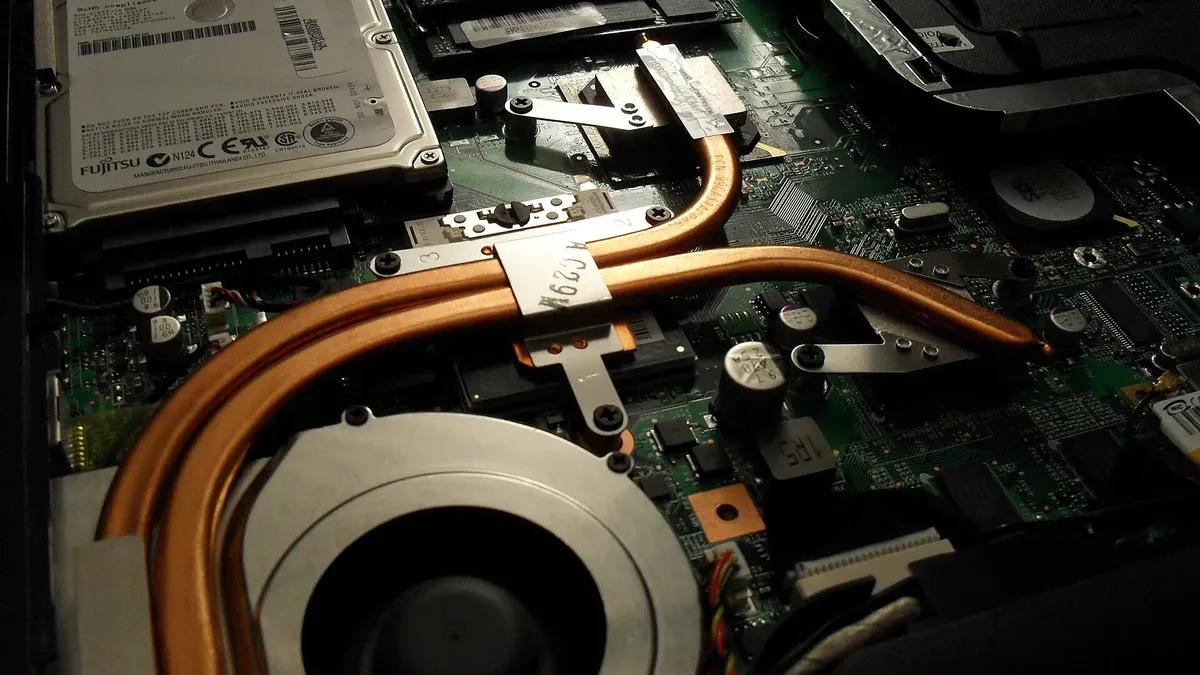
A heat pipe works exactly the same way, just inside a sealed tube: liquid evaporates at the hot end, condenses at the cool end and returns along a wick. According to NASA (National Aeronautics and Space Administration), heat pipe technology used to cool spacecraft hardware found its way into notebook computers, where tiny heat pipes cool the main processor.
The difference is shape. A narrow, finger-like heat pipe is good at carrying heat along a line to somewhere farther away; a thin, wide vapor chamber is good at spreading heat from one hot spot in every direction. Engineers call this one-dimensional versus two-dimensional heat transfer.
| Heat pipe | Vapor chamber | |
|---|---|---|
| Shape | Long, narrow tube | Thin, wide plate |
| Where heat goes | Along the tube (1D) | Across the plate (2D) |
| Best at | Carrying heat somewhere else | Spreading heat from a hot spot |
| How it works | Evaporation, condensation, capillary wick | Same |
| Phone examples | Galaxy S7 (2016) | Galaxy S10+ (2019), iPhone 17 Pro (2025) |
Both move heat far better than a solid block of metal: Samsung said the Galaxy S7’s heat pipe generally conducts heat more than 50 times better than copper. There are limits, though. Stanford engineering professor Kenneth Goodson told IEEE (Institute of Electrical and Electronics Engineers) Spectrum that the thinner a vapor chamber gets, the faster its advantage over copper shrinks. Vapor chambers also tend to be expensive to make.
Why do phones need cooling at all?
A chip heats up as it works. Samsung’s engineers have explained that once it reaches a certain temperature, the chip lowers its clock rate (how fast it runs) to stop heat from building up. This is thermal throttling, and it is why a long gaming session can start to stutter. So good cooling shows up less in peak speed than in sustained performance: how long a phone can keep running fast.
A vapor chamber doesn’t make heat disappear; it spreads heat out so the phone can get rid of it. Most phones have no fan, so the spread-out heat passes into the frame and the back and finally leaves through the surface into the air.

If a phone still gets too hot, it protects itself. According to Apple Support, an overheated iPhone may slow or stop charging, dim its display and run some apps at lower frame rates. Apple advises turning it off and moving it somewhere cooler, out of direct sunlight, until it cools down. iPhone is designed for ambient temperatures of 0° to 35°C (32° to 95°F), and Apple warns against leaving it in a parked car, which can get hotter than the 45°C (113°F) storage limit.
What’s different about the vapor chamber in iPhone Duo?
Android phones had this technology before iPhones did. Samsung put a water-based heat pipe in the Galaxy S7 in 2016 and a vapor chamber cooling system in the Galaxy S10+ in 2019. Apple followed in September 2025 with iPhone 17 Pro, its first iPhone with a vapor chamber: deionized (ion-free) water sealed in a chamber laser-welded into the aluminum chassis, which passes the heat into the aluminum unibody.
iPhone Duo goes a step further. According to Apple, a new chip package inspired by the M-series chips Apple uses in Macs connects the A20 Pro directly to a custom vapor chamber. (A chip package is the casing that holds a chip and links it to the circuit board.) Apple says the A20 Pro and this thermal system together give iPhone Duo up to 35 percent better sustained performance than iPhone 17 Pro.
Note that the 35 percent is Apple’s own figure and reflects the chip and the whole thermal design, not the vapor chamber alone. Reviews after the 23 October release will show how cool the phone really stays in a long gaming session.
In short
A vapor chamber is a sealed, low-pressure metal plate in which a little water evaporates and condenses over and over to spread a chip’s heat. It works like a heat pipe, but in two dimensions instead of one, and iPhone Duo connects its A20 Pro chip directly to one.
More from this issue
 iPhone Duo release date and price: what's new in Apple's first foldable?
 eSIM vs SIM card: what is an eSIM, and why is iPhone Duo eSIM-only?
 Why do foldable phones have a crease, and does the iPhone Duo have one?
 What does IP68 mean, and can you shower with a waterproof phone?
 What does 2nm mean? 2nm vs 3nm, and is a 2nm chip really 2 nanometers?
People also ask
What liquid is inside a vapor chamber?
Usually a small amount of water, held in a wick (a layer of fine metal mesh or metal powder) inside a sealed plate with the air pumped out. The low pressure lets the water turn to vapor well below 100°C (212°F). Apple says the vapor chamber in iPhone 17 Pro holds deionized water.
What is thermal throttling?
It is when a chip slows itself down because it is getting too hot, so that it makes less heat. A long gaming session that starts to stutter is a typical sign. Better cooling delays throttling, so the phone keeps high performance for longer.
Does a vapor chamber stop my phone from getting hot?
No. A vapor chamber does not destroy heat; it spreads it out so the phone's body can release it, so the phone can still feel warm under heavy use. Apple says a device can feel warmer during setup, wireless charging or graphics-heavy games and that this is normal. If a temperature warning appears, turn the phone off and let it cool somewhere out of direct sunlight.
Sources
- Apple Newsroom - Apple unveils iPhone Duo (9 Sep 2026)
- Apple Newsroom - Apple unveils iPhone 17 Pro and iPhone 17 Pro Max (9 Sep 2025)
- Apple Support - If your iPhone or iPad gets too hot or too cold
- IEEE Spectrum - Water Vapor Could Cool Your Next iPhone (17 Sep 2025)
- Samsung Newsroom - How We Created the Cooling System in the Galaxy S7 and S7 edge (14 Apr 2016)