Science & techIssue OLED touchscreen MacBook Pro: release date, price and what's new?
Q. What is contrast ratio, and what does 10,000,000:1 really mean?
Apple’s new MacBook Pro, the first Mac with a touchscreen, arrives with an OLED (organic light-emitting diode) display and a headline number: a 10,000,000:1 contrast ratio. Monitor spec sheets often list 1,000:1, so that is four more zeros. What is contrast ratio, and what does 10,000,000:1 really mean?
The short answer: contrast ratio is the brightest white a screen can show divided by the darkest black it can show at the same time, so at the same white, a 10,000,000:1 screen’s black is 10,000 times darker than a 1,000:1 screen’s. You notice that most in a dark room. In a lit room, reflections shrink the gap, and makers measure contrast differently, so spec sheets rarely compare cleanly.
What does contrast ratio actually measure?
RTINGS, a review site that lab-tests screens, calculates contrast ratio by dividing the luminance of a display’s white by that of the black it shows at the same time. There is no unit: 1,000:1 means white is 1,000 times brighter than black.
Say a screen’s white measures 500 nits and its black 0.5 nits: 500 ÷ 0.5 = 1,000, a 1,000:1 contrast ratio. Drop the black to 0.05 nits and you get 10,000:1. For 10,000,000:1 with a 1,000-nit white, the black would have to be 0.0001 nits.

What is a nit, and how bright are 500 or 1,000 nits?
A nit is one candela per square metre (cd/m²), the unit of luminance, or how brightly a surface glows. The US National Institute of Standards and Technology (NIST) notes that a one-candela source looks about as bright as an old wax candle. Roughly, 1 nit is a one-metre-square panel glowing with the light of one candle; at 500 nits, it glows like 500 candles.
Apple rates the MacBook Air display at 500 nits. The MacBook Pro’s Liquid Retina XDR display, lit by mini-LEDs (tiny light-emitting diodes), reaches up to 1,000 nits for SDR (standard dynamic range) content in bright light, peaks at 1,600 nits for HDR (high dynamic range) content, and dims to 1 nit in the dark.
Is 1,000:1 contrast good, and how do screen types compare?
It depends on how the screen makes black. An LCD (liquid crystal display) shines a backlight through liquid crystals that act as shutters, which never block all the light. In RTINGS’s examples, an IPS (in-plane switching) monitor measured 1,020:1 and a VA (vertical alignment) monitor 4,508:1, and RTINGS calls 3,000:1 good. So 1,000:1 is ordinary for an LCD: even on a black screen, a little backlight leaks through.
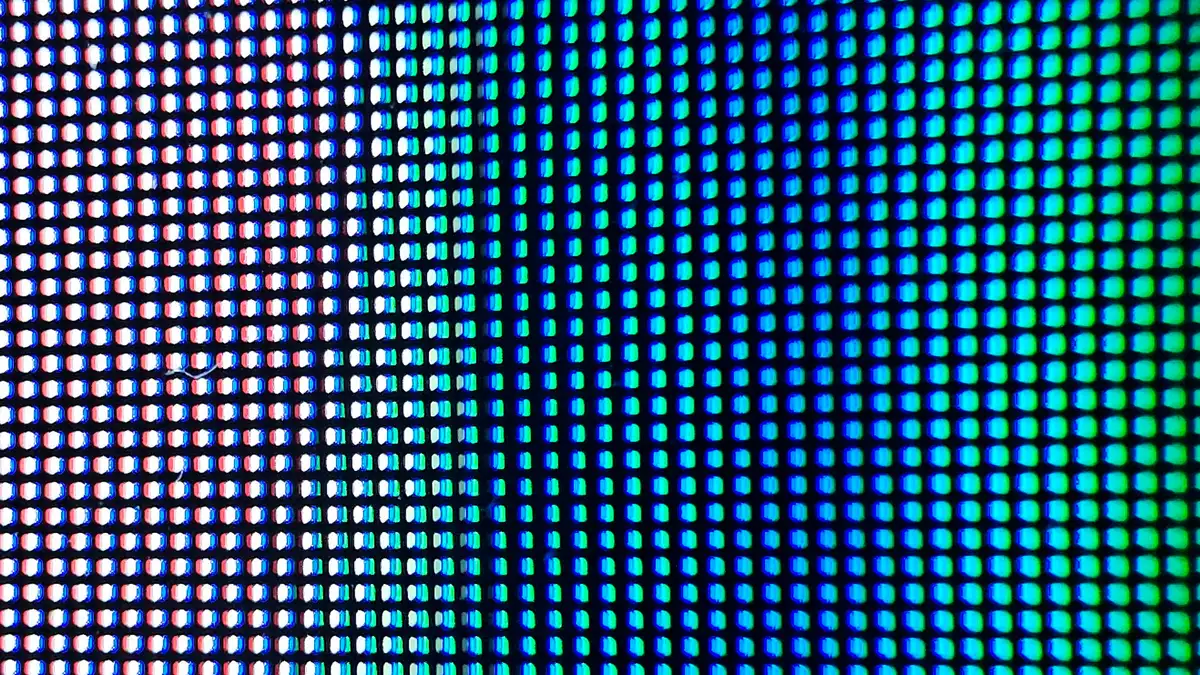
Local dimming splits the backlight into zones and dims the ones behind dark areas; mini-LED backlights use many tiny LEDs to keep the zones small. The zones are still much larger than pixels, so a bright object on a dark background can show a halo. On an OLED, every pixel makes its own light and switches off for black. With the bottom of the fraction near zero, contrast becomes effectively infinite, and RTINGS lists OLED monitors as Inf:1.
| Screen type | How it makes black | Example contrast |
|---|---|---|
| IPS LCD | Liquid crystal blocks the backlight (some leaks) | 1,020:1 (RTINGS test) |
| VA LCD | Liquid crystal blocks more of it | 4,508:1 (RTINGS test) |
| Mini-LED LCD (Liquid Retina XDR) | Dims backlight zones behind dark areas | 1,000,000:1 (Apple spec) |
| OLED | Pixels switch off | Inf:1 (RTINGS test) |
| Tandem OLED (new MacBook Pro) | Two pixel layers; pixels switch off | 10,000,000:1 (Apple spec) |
The figures come from different methods, so they are not a single ranking.
Does a higher contrast ratio always look better?
In a dark room, mostly yes. RTINGS says higher contrast means deeper blacks in dark rooms and matters most for dark scenes, bright objects on dark backgrounds and HDR; low contrast can look washed out.
In a bright room, reflected light adds to white and black alike. A 2020 review by University of Central Florida researchers gives a formula for this “ambient contrast ratio”. Under 500 lux of office light, if the screen reflects 2% of it (the paper cites 0.5 to 4%), about 3 nits of reflection land on the black. With a 500-nit white, a 1,000:1 screen drops to around 140:1, and an OLED, counting its black as zero, to around 160:1. A gap of 1,000:1 against infinity shrinks to less than 1.2 times.
In bright places, brightness and anti-reflective coatings matter more than the contrast spec. By the same formula, a brighter white and a less reflective surface make black text on a white page crisper.
Why can’t you compare contrast ratios across brands?
Because the result depends on what the screen shows during the test.
- Full on/off: measure an all-white screen, then an all-black one. Local dimming can switch the whole backlight off for the black frame, inflating the result, and RTINGS notes that some manufacturers may quote figures this way to look better.
- Checkerboard: white and black squares share the screen, as in the 16-square pattern from ANSI (the American National Standards Institute), so black must hold up right next to white, as in real content.
- Dynamic contrast: the backlight dims for dark scenes and brightens for bright ones, so white and black come from different scenes. Monitor maker BenQ contrasts native figures like 2,500:1 with dynamic figures like 20,000,000:1.
RTINGS even warns readers not to compare its own results with manufacturers’ or other reviewers’. The Video Electronics Standards Association (VESA), the display industry’s standards group, tackles that confusion by spelling out test patterns for its DisplayHDR certification.
What does 10,000,000:1 mean for the new MacBook Pro?
The new MacBook Pro’s PROLED XDR display is a tandem OLED with two layers of self-illuminating pixels. Apple quotes a 10,000,000:1 contrast ratio and “up to 2000 nits peak HDR and SDR brightness”. The mini-LED Liquid Retina XDR display, used on 14- and 16-inch MacBook Pros since 2021 and kept on the new 14-inch M6 model announced the same week, is rated at 1,000,000:1 and 1,600 nits peak HDR. By Apple’s own figures, that is ten times the contrast and 1.25 times the peak HDR brightness.
Apple says the display shows deep blacks without blooming or halos. Because each pixel switches off on its own, black stays black even beside a bright highlight. Apple does not say how it measured 10,000,000:1. Since OLED contrast is often called infinite anyway, read it as “black gives off almost no light”, not as a number to rank against other brands. Apple credits bright-light readability to the 2000-nit brightness and an antireflective coating, which fits the reflection math above.
In short
Contrast ratio is a screen’s brightest white divided by its darkest black, both measured in nits (cd/m²). At the same white, a 10,000,000:1 screen’s black is 10,000 times darker than a 1,000:1 screen’s, which shows in a dark room but fades under room reflections. Methods differ, so compare only contrast ratios measured the same way.
More from this issue
 OLED touchscreen MacBook Pro: release date, price and what's new?
 What is tandem OLED, and how is it different from regular OLED and mini-LED?
 What is OLED burn-in, what causes it, and how do you prevent it?
 What is the Dynamic Island, and what does it do on iPhone and Mac?
 What is refresh rate, and can you see the difference between 60Hz and 120Hz?
People also ask
Is a 1,000:1 contrast ratio good?
It is ordinary for an LCD. In RTINGS's examples, an IPS monitor measured 1,020:1 and a VA monitor 4,508:1, and RTINGS gives 3,000:1 as an example of good contrast. The difference shows most when you watch dark scenes in a dark room; in a bright room, reflections hide much of it.
What is a nit, and how bright are 500 or 1,000 nits?
A nit is one candela per square metre (cd/m²), the unit for how brightly a screen glows. A 1,000-nit screen gives off twice the light of a 500-nit one from the same area. Apple rates the MacBook Air display at 500 nits, and the mini-LED MacBook Pro reaches up to 1,000 nits for SDR content in bright light. Extra brightness helps most outdoors and in bright rooms.
Why is OLED contrast called infinite?
Because each OLED pixel makes its own light and switches off to show black. Contrast is white divided by black, so as black approaches zero the ratio grows without limit, which is why RTINGS lists OLED monitors as Inf:1. Makers still quote finite figures, such as Apple's 10,000,000:1 for the new MacBook Pro.
Sources
- Apple Newsroom - Apple unveils groundbreaking MacBook Pro with PROLED XDR Display and Touch for the first time on Mac (Oct 28, 2026)
- Apple - MacBook Pro with Liquid Retina XDR Display
- RTINGS - Our Monitor Picture Quality Tests: Contrast
- VESA DisplayHDR - Performance Criteria (CTS 1.2)
- Huang et al. - Mini-LED, Micro-LED and OLED displays: present status and future perspectives (Light: Science & Applications, 2020)
- NIST - Candela
- BenQ - What is Dynamic Contrast and Why You Should Try It
- Apple - MacBook Air Tech Specs
- Apple Newsroom - Apple unveils game-changing MacBook Pro (18 Oct 2021)