Science & techIssue OLED touchscreen MacBook Pro: release date, price and what's new?
Q. What is tandem OLED, and how is it different from regular OLED and mini-LED?
Apple’s new MacBook Pro, announced on 28 October as the first Mac with a touchscreen, also gets an all-new display. Apple calls it PROLED XDR and says it uses tandem OLED (organic light-emitting diode) technology. OLED is familiar from phones, but “tandem” is new, and it’s not obvious how it stacks up against the mini-LED screens MacBook Pro has used until now. So what exactly is tandem OLED, and how is it different from regular OLED and mini-LED?
The short answer: tandem OLED is an OLED display with two light-emitting layers stacked on top of each other, and because both layers shine together, it can get brighter on the same current or last longer at the same brightness. Mini-LED is a different animal: an LCD (liquid crystal display) lit from behind by a dense grid of tiny LEDs, while in any OLED each pixel makes its own light.

What is OLED, and what does “tandem” mean?
OLED stands for organic light-emitting diode. Each pixel holds thin layers of organic (carbon-based) material that glow when electricity flows through them.
Because every pixel makes its own light, a black pixel can simply switch off, giving a true black. There is no backlight behind the screen, which helps keep it thin, and OLED can even be built on bendable plastic.

The weak spot is that organic materials wear as they are used. Apple notes that single-layer OLED panels have long struggled to sustain high brightness, and it lists burn-in risk, the faint ghost a static image can leave behind, among OLED’s limitations. Tandem OLED tackles this by adding a second emitting layer. “Tandem” means one behind the other, as on a tandem bicycle, where two riders pedal together.
How does tandem OLED work?
A tandem panel builds two complete sets of red, green and blue emitting layers and stacks one on top of the other. Because the two layers share the work of lighting each pixel, Apple says, each one runs on less current.
Samsung Display puts it simply: with two layers glowing at once, the same current yields more light, or the same light asks less of each layer, which stretches the panel’s life. A second layer gives designers room to trade between more brightness and a longer life. Think of the bicycle again: two riders can go faster, or cruise at the same speed with less effort each.
What are the benefits of tandem OLED, and the downsides?
Samsung Display says its laptop tandem OLED, in full-scale supply since July 2026, reaches up to 1,600 nits (a unit of screen brightness) at the panel level, more than 40% above the 1,100-nit peak of a conventional single-stack OLED, and lasts more than twice as long at typical laptop brightness. LG Display, which began mass-producing the industry’s first tandem OLED for laptops in June 2024, said it can deliver double the lifespan and triple the brightness of a single-layer OLED while cutting power use by up to 40%. These are the companies’ own figures.
The catch is cost. Research firm Omdia estimated in April 2025 that tandem tablet and notebook panels are 50% to 75% more expensive to manufacture than single-layer OLEDs. A second stack means more evaporation steps (vaporizing organic material into a thin film) and more fine metal masks, perforated sheets that guide the material onto each pixel. That uses more material and lowers production yields, Omdia says.
What’s the difference between mini-LED and OLED?
A mini-LED display is a kind of LCD. Liquid crystals can’t make light, so they need a backlight, and mini-LED builds that backlight from thousands of tiny LEDs. On the 12.9-inch iPad Pro, Apple says more than 10,000 mini-LEDs are grouped into more than 2,500 individually controlled zones. This zone-by-zone control is called local dimming.
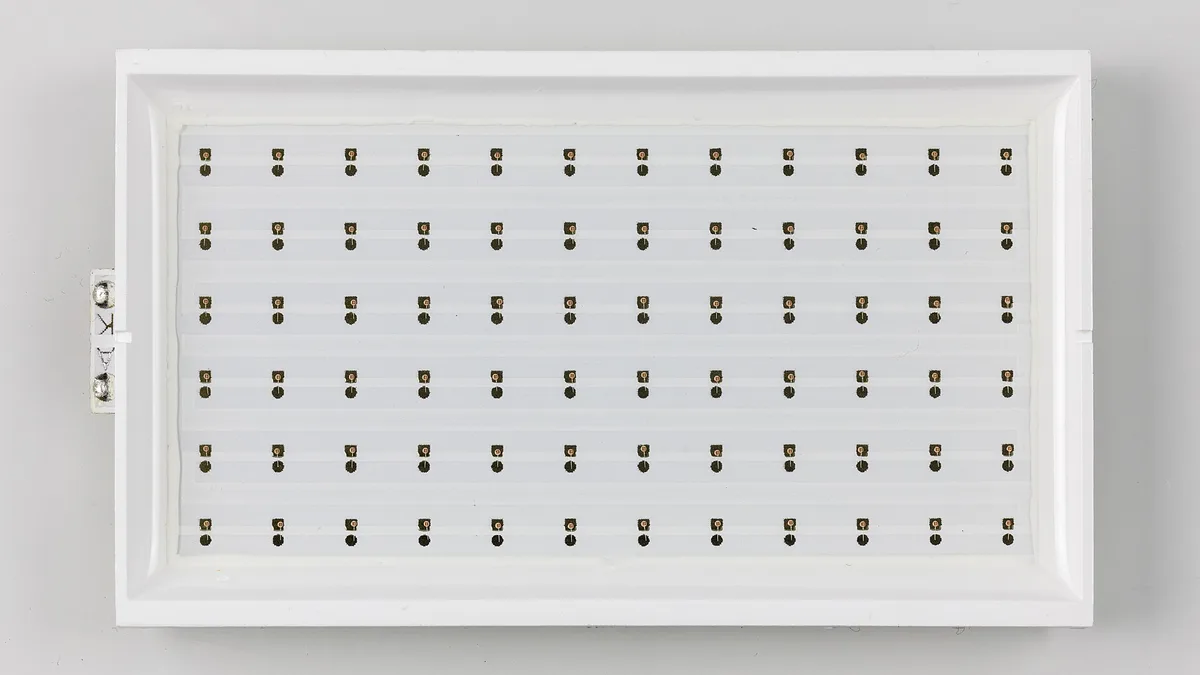
Mini-LED screens can get very bright and show fairly deep blacks. The limit is zone size. Each zone is much larger than a pixel, so when a bright object sits on a black background, light spills into the dark pixels sharing its zone and shows up as a soft glow called blooming, or a halo. Apple says typical local dimming systems can show slight blooming for exactly this reason, and that its own design improves on those trade-offs. OLED pixels switch on and off one by one, so they don’t bloom. Mini-LED controls light zone by zone; OLED controls it pixel by pixel.
| Regular OLED | Tandem OLED | Mini-LED | |
|---|---|---|---|
| Light source | One emitting layer per pixel | Two stacked emitting layers per pixel | Tiny LEDs in a backlight behind an LCD |
| Black | Pixel switches off: true black | Same as regular OLED | Zones dim; deep, but can bloom |
| Brightness | One layer does all the work | Two layers share it: brighter | Easy to make very bright |
| Lifespan and burn-in | Organic material wears; burn-in risk | Longer life, per the makers; risk remains | No organic emitters to wear; blooming instead |
| Thickness and cost | Thin, no backlight | Thin; 50–75% costlier to make (Omdia) | Backlight adds thickness |
| MacBook Pro main screen | Never used | PROLED XDR (2026) | Liquid Retina XDR (since 2021) |
How did tandem OLED get from cars to the MacBook Pro?
Cars came first. LG Display says it commercialized tandem OLED in 2019 and used it first in car displays, where quality standards are especially strict, because spreading out the energy lets the panels run reliably for longer.
Among Apple products, the iPad Pro with M4, announced on 7 May 2024, got tandem OLED before the Mac did; Apple called that screen Ultra Retina XDR.
Now it is the Mac’s turn. According to Apple’s technical overview, PROLED XDR is the first Mac display to use OLED at all. Apple says its two self-illuminating pixel layers deliver deep blacks without blooming or halos, a 10,000,000:1 contrast ratio (the gap between the brightest white and the darkest black) and up to 2000 nits peak HDR (high dynamic range) and SDR (standard dynamic range) brightness. Apple also credits OLED’s more efficient display stack for a slimmer design: the 16-inch model is nearly a millimeter thinner and the 14-inch half a millimeter.
The new 14-inch MacBook Pro with M6, announced a day earlier on 27 October, keeps the mini-LED Liquid Retina XDR display, which Apple rates at a 1,000,000:1 contrast ratio and 1600 nits of peak HDR brightness. Reviews after both go on sale on 6 November will show how different they really look.
In short
Tandem OLED stacks two light-emitting layers so a screen can shine brighter on the same current or last longer at the same brightness. Like any OLED it lights each pixel on its own, avoiding the blooming of zone-lit mini-LED, but it costs more to make. Proven in cars first, it reached the iPad Pro in 2024 and now the MacBook Pro.
More from this issue
 OLED touchscreen MacBook Pro: release date, price and what's new?
 What is OLED burn-in, what causes it, and how do you prevent it?
 What is the Dynamic Island, and what does it do on iPhone and Mac?
 What is refresh rate, and can you see the difference between 60Hz and 120Hz?
 What is contrast ratio, and what does 10,000,000:1 really mean?
People also ask
Can tandem OLED still get burn-in?
Yes. Makers say each layer carries less load, so a tandem panel lasts longer, but organic materials still wear as they are used, so the risk does not go away. Apple itself lists burn-in risk among OLED's long-standing limitations.
When is mini-LED blooming most visible?
When something bright sits on a black background, such as white text or a small bright dot on a dark screen. The backlight zone behind it lights up, and the glow can spill into nearby black pixels. Apple says typical local dimming systems can show slight blooming because their LED zones are larger than the LCD's pixels.
Why is tandem OLED more expensive?
Because the light-emitting layers have to be laid down twice. Research firm Omdia says tandem panels need more evaporation steps and fine metal masks, which use more material and lower production yields, making tandem tablet and notebook panels 50% to 75% more expensive to manufacture than single-layer OLEDs.
Sources
- Apple Newsroom - Apple unveils groundbreaking MacBook Pro with PROLED XDR Display and Touch for the first time on Mac (28 Oct 2026)
- Apple - PROLED XDR Display Technology Overview (Oct 2026, PDF)
- Samsung Display - Samsung Display Sets a New Brightness Standard for Premium Laptops with VESA DisplayHDR True Black 1400 Tandem OLED (20 Jul 2026)
- LG Display - LG Display Starts Mass Production of Industry's First Tandem OLED for Laptops (24 Jun 2024)
- Apple Support - About the Liquid Retina XDR display on iPad Pro
- Omdia - Tandem Penetration Forecast to Reach 36% Share of OLED Tablet and Notebook Panel Market in 2026 (24 Apr 2025, press release via Silicon UK)
- Apple Newsroom - Apple unveils stunning new iPad Pro with M4 chip and Apple Pencil Pro (7 May 2024)
- Apple - MacBook Pro, compare models (the M6 14-inch's mini-LED display, checked 30 Oct 2026)